Header Photo Credit

*The stunning photo in the header of my blog is all thanks to Ron Shoshani. Visit his facebook page for more of his amazing photographs of Tel Aviv!
Showing posts with label Tel Aviv. Show all posts

Monday, June 13, 2011

Tel Aviv Gay Pride Parade 2011

Photo Credit: Burghard Mannhofer
The Tel Aviv Gay Pride Parade has flaunted its rainbow colors yet again and filled the streets and beaches with gorgeous drag queens, bikini-clad lesbians, proud supporters of gay rights and everyone in between. The parade somehow seems to get bigger and better every year, drawing larger crowds and higher numbers of tourists.

This year statisticians estimate that more than 100,000 Israelis and an added 5,000 tourists took part in the parade entitled "It's good to be gay – marching for social equality."

"I have come to say that being part of the gay community, to be gay or lesbian or any other member of the community, is not a political choice as is the choice to protect the gay community and its right for social equality," opposition leader Tzippi Livni told Haaretz.com, adding "we are here to fight together against any phenomenon of hate, to fight for Israel's values."

Photo Credit: Burghard Mannhofer
What I love about the Tel Aviv Gay Pride Parade is first and foremost the fact that it dominates the entire city, but with such welcoming energy that it's easy to participate. In fact, if you are in the White City on the day of the parade, its nearly impossible to avoid joining in the festivities.

Throughout the course of the day roads are closed down, colorfully costumed people pour through the streets and the biggest beach, Gordon beach, is turned into a huge performance stage and outdoor bar.  The parties continue on through the evening, the rest of the weekend and the rest of the month- as June is designated as Gay Pride month.

Photo Credit: Burghard Mannhofer

People come from all over the world to participate or simply observe Tel Aviv's annual Gay Pride Parade as Tel Aviv boast one of the largest and most active gay communities in the world. In fact, according to Tel Aviv's  deputy mayor, Asaf Zamir, nearly17% of the city's population is gay.

"It's a very strong community here, a comfortable arena for the gay community. Two men walking hand in hand is a very normal thing," he told UK newspaper, The Guardian.

This year's 2011 Tel Aviv Gay Pride Parade got tons of international press  from newspapers such as The Guardian, the AFP, el Mundo and The Sydney Morning Herald, and rightly so.

To give you a taste, I put together a small slideshow of the events calendar for the entire month, including the parade itself, as well as some snapshots by a great Israeli Photographer, Gadi Gilon. Hopefully this will help you get an idea of the extravagance and exuberance of this year's 2011 Tel Aviv Gay Pride Parade.


Tuesday, May 17, 2011

My Sinuses Can Predict Israeli Heat Waves (Hamsin)


Yes, it's true. My sinuses have magical powers.

I realized this last night when I woke up in a sudden sneezing fit that involved runny nose-ness and a strange sensation that I may not ever be the same again.

After I finally sneezed myself silly and collapsed back into sleep after exhausting my nose muscles (do I even have nose muscles?)  I woke up, showered, and decided it was up to me to figure out who or what the culprit was.

Only after I opened my living room window to breathe in the humid, dust-filled, gloomy gray air did I put two and two together.

Hamsin.  The Israeli hamsin (which comes from the Arabic word khamsīn) is characterized by what looks like a dark cloud of sand hanging over the sky, trapping in heat and humidity and making everyone living beneath it uncomfortable. In Tel Aviv they are the wooooorrrrrrrst.

Photo Credit: Baba Yagada

Its totally gross and only escapable if you have full-blast high-power air-conditioning. (which, of course, I don't being semi-poor and more-than-somewhat concerned with the environment.)

The painting above is an spot-on representation of a typical day in a Tel Aviv Hamsin full of hot sand-filled winds.

So, weathermen, if you are looking for a young, hard-working professional who can help you predict the hottest and most grueling Hamsins, I'm your gal.

Wednesday, January 5, 2011

Israel's Immigrant Anglo Students Don't Want to Learn Hebrew. Shocker!


English speaking students at Bar Ilan University protested high prices for test translations and unfair conditions for new immigrants who don't speak Hebrew.

Are any of us surprised that English speakers feel no need at all to learn another language when the move to a new country? I'm not. Why? Well, because I see this happen every day.

Tuesday, January 4, 2011

Americans who don't know sh#$t about Israel.

I know these things are always edited to showcase the dumbest of the dumb...but really?!  I mean, seriously?

Watch this and you will feel smart.

These college kids must have killed all of their brain cells doing bong hits and keg stands at some crazy frat party.

Tuesday, August 17, 2010

Palestinian Shot at Turkish Embassy: What is really going on here?

I gotta write about it because it is so hot write now that newspapers and blogs just can't seem to stop spewing out news about it. But what "it" is, exactly, wasn't clear for hours.  

Some reports say that a Palestinian man was running around the streets naked before he entered the Turkish Embassy demanding asylum.  Others say he took his wife hostage along with the consul of the embassy, while others deny those claims completely. Some reports say that shots were fired at the Turkish Embassy, others claim they were fired outside of the embassy and still others claim two separate incidents: one outside and one inside.

Photo credit: Associated Press.  Police Outside The Turkish Embassy in Tel Aviv

What everyone does seem to agree on a this point, at least, is that the man who has been causing all the trouble, Nadim Injaz from Ramallah, was shot in his leg during the commotion and has since been apprehended by authorities. He is in good condition, according to Turkish embassy reports, and is waiting to be transferred to Tel Aviv's Ichilov hospital under police guard.

So what exactly happened?

Mr. Injaz, armed with a knife, a can of gasoline and what appeared to be a gun (but later turned out to be a toy) burst into the Turkish Embassy Tuesday, August 17th 2010, demanding political asylum.  According to a statement released by the Turkish Embassy, he entered shouting for asylum and immediately tried to take the consul hostage as guards attempted to detain him.

Apparently, Injaz made a call to the Channel 2 news media while he was inside and threatened to "kill any Jews" who entered the scene. According to Haaretz.com news report, Injaz continued in his rant to Channel 2 saying,

"If they don't let me leave this country now I will burn down the whole building. I will burn everything. I will burn the cars, the doors I will break down the doors. I will break everything."
He said he was demanding asylum and protection from "these murderers the
Zionists, the murdering Jews." At the same time, he said that Palestinian leaders, including President Mahmoud Abbas, "should die."
Injaz remained for six hours within the Embassy walls after shots had been fired and the Magen David Adom, ( Israeli Red Cross), police force and ambulances had arrived at the scene.  None of the Israeli authorities were permitted to enter the Embassy boundaries, being that it is technically Turkish soil. During this time, helcopters circled overhead and Israeli authorities blocked off Hayarkon street, a main street that runs north-south along the Tel Aviv boardwalk.  Everyone waited anxiously for an update from embassy officials.

Photo Credit: Yaron Brener, ynet.com.  Police waiting for update from embassy officials.

Despite many attempts to call the embassy in an effort to help treat any individuals wounded during the exchange, the police, red cross and emergency personnel had no luck reaching the Turkish Embassy officials who refused to answer any calls and kept their doors tightly shut. It seems that the embassy staff is waiting for specific instructions from Ankara before escorting Mr. Injaz to a hospital or taking any further actions.

Israeli media has painted the picture of a man with a a history of erratic behavior and a serious criminal record.  To begin with, he's pulled a stunt like this before.  Only four years ago, Mr. Injaz scaled a wall of the Britsh Embassy in his first attempt to be awarded political asylum.   He also allegedly worked as an informant with Palestinian as well as Israeli security services in the past.  According to the Jerusalem Post,

"Injaz has a troubled past, allegedly working for Palestinian security forces in mid-1990s after his brother was discovered to be an Israeli collaborator, and later as an Israeli informant himself.

Injaz reportedly told a human rights researcher that he was promised Israeli identity papers by Israeli intelligence for his work as an informant, but they never came through on their side of the bargain. Since then he has been in and out of Israeli prisons on petty criminal charges or for lacking identity papers and repeatedly expelled to the West Bank, only to keep coming back to Israel." 

Ynet goes even further in it's detailed coverage with reports from Injaz's attorney, Avital Horef.  Mr. Horef told Ynet that barricaded himself at the British embassy in a desperate attempt to save himself when it became clear to Injaz that he was wanted by Palestinian Authorities in the West Bank.  After his barricade, he was  awarded permission from Israeli authorities to reside in Israel, but was not granted a working permit. With no source of income, Injaz began to steal, and was arrested and jailed by the Israeli police.

Photo Credit: REUTERS/Eli Dassa/Maariv.
Nadim Injaz looks out of Turkish Embassy window in Tel Aviv during barracade.

Mr. Horef continued:

"While [Injaz] was still in jail he contacted me and asked me to sort out permission for him to reside in Israel," said Horef. "I petitioned the High Court for this even before his release, and to get a temporary injunction to prevent his deportation to the occupied territories, where a death sentence awaited him."

"About two weeks ago the temporary injunction was cancelled in a High Court deliberation," Horef continued. "When Injaz was released, he was taken to the Judea and Samaria checkpoint, and like anyone who wants to live, he escaped back to Israel. Today he came to the Turkish embassy in order to sort out his troubles and obtain political asylum."

Now the question is, why all the hoopla? Is Injaz crazy, or is he a product of the mad Israeli-Arab-Palestinian politics?  It sounds to me like he's a pretty desperate guy who is very scared of death, believes that many people are out to kill him, and has lots of hate pent up in his heart. It certainly doesn't sounds like he's led anything resembling a normal, stable or easy life. He's so scared that stormed not one, but two embassies in Israel.  In the end of things, all he wants is to live and work in a country where he can feel like he is a free citizen. 

I'm sure that more will soon come to light as this story unfolds, but for now, my first impression is that this poor man has been driven to the edge, and no one really knows what to do with him now. 

Friday, August 13, 2010

National Geographic Top Ten Beach Cities: Tel Aviv Is #9!

Gordon Beach in Tel Aviv

According to National Geographic, Tel Aviv is the #9 best beach city in the world.  Who knew?! Well basically everyone, at this point: the article came out nearly a month ago. While us Tel Avivians happily accept the compliment, I can't help wondering what it means, exactly.

 A "Top Ten Beach City": is it a true and full assessment of the city+beach combination?  Did they concoct some scientific formula that calculates how the awesomeness of both beach and city are mutually dependant?  Do they evaluate the beach and city separately? Is it just another "Top Ten" title to draw readers and internet surfers?  Or are they just a list of cool cities that happen to have beaches nearby? I'm not quite sure what NG's criteria was, but it certainly couldn't be clean sands and crystal clear water:  The Tel Aviv beaches are laden with cigarettes and plastic crap, paddle ball players and dogs.

And yet, the N.G. team labled Tel Aviv the "Miami Beach on the Mediterranian". While I won't argue with the awesomeness of Tel Aviv, and I can't contend with the fact that the beach definitely adds to the value of the city....I do have some issues with their little blurb:


"Call it Miami Beach on the Med. Tel Aviv is the Dionysian counterpart to religious Jerusalem. In the “bubble,” as it’s known for its inhabitants’ tendency to tune out regional skirmishes, some restaurants, discos, and clubs are open until dawn. By day, the scene shifts to the city’s promenade and eight miles (13 kilometers) of beach literally steps from town. Head to wide and sandy Gordon Beach to sit in a seaside café or take a dip in the saltwater pool."


Whatever you call Tel Aviv, it is definitely not Miami Beach. Miami Beach is known for having some of the cleanest, sandiest, most well patrolled beaches in the United States. Not to mention the availability of public facilities.  Much of Miami Beach is also privately owned, unlike the beach in Tel Aviv which is entirely public. This has most likely led to the general lack of clean restrooms, working   It is much smaller, much dirtier, and much more crowded.

To be honest, Gordon Beach, the beach that National Geographic specifically highlights, is the one beach that I typically avoid.  Due to the width of its sandy coast, beach events are frequently set up there including beach volley ball, concerts and other special activities.  It is cradled by the beginning of the hotel strip which has made it conducive to the settlement of cheesy bars, tourist oriented kiosks (bodegas), and overpriced fast food restaurants.  Of course, all of these events, bars and hotels has made Gordon Beach possibly the most polluted beach in all of Tel Aviv.  I refuse to go in the water. Its usually swimming with plastic bags, bottles and warm with the urine of young European toddlers.

Photo from treehugger.com

All of that said, I love this city and there is something about the dirtiness that in some way implies freedom.  Don't get me wrong.  I'm not promoting littering or pollution.  However.  There are no policemen patrolling the Tel Aviv beaches. There are very few signs prohibiting this and warning you of that.  While there are life guards on duty till about 6:00pm, and they do their job well,(despite the fact that they abuse their speaker-phone at times to whistle at good looking women) they aren't angry, reprimanding or cruel. You can set up your blanket on the beach, crack open a beer, lie out in the sun, and do your thing.

In the end of things, dirty or not, the beach is always a promise of freedom: the possibility of escape, the suggestion of new worlds unknown that lay just beyond the horizon.  It's a place where you can strip down and show your skin.  You can feel beautiful and healthy.  You can heat up in the sun and cool down in the water. And in Tel Aviv, everyone is welcome.

In Tel Aviv, the beach saves the city in the summer when the heat becomes unbearable.  The sea makes the heat "worth the while" with calm, pleasant Mediterranean waters and soft sand.  It also contributes to the laid-back attitude, especially regarding dress code.  And, it keeps everyone looking, or trying to look, pretty darn fit.

In the end of things, I don't really care if National Geographic got their facts all right.  They got the gist of it.  Tel Aviv, with its beaches and it's land-life, is a pretty fantastic city.

Wednesday, August 4, 2010

Making Aliyah in Tel Aviv- A Glance Back at My First Day as an Israeli Citizen

In light of my most recent post about marriage in Israel, I dug out my ruminations that I sent out to friends and family when I first made Aliyah...way back when I had long hair.

My relationship with Israel is a complicated affair.  You could call it a love/hate relationship, but it's more complicated than that. I think it comes down to the fact that we're both still trying to find ourselves.

Some of you have already read this.  Think of it as a nice refresher. Plus, I edited it a bit so that it reads a bit better.

 My love for this country and my fascination with Israel runs deep, despite the fact that I don't agree with everything that happens here.

Me and my brother in Israel 1995 (gotta love the hats)

"Yesterday morning, it was my turn. After waiting in a large gray hallway lined with uncomfortable gray metal chairs, it was finally my turn.  I'd watched for almost an hour as Russians, Koreans, Vietnamese, French,Spaniards, and Ethiopians jumped up at the call of their mispronounced name and entered the room behind the security guard with a thick Russian accent. 

Now it was my turn. I sat down at a big gray desk and handed over my birth certificate,  a letter from my rabbi confirming my maternal Jewish lineage, and my passport to a thin olive-skinned woman. I bit my nails and tried my best not to look to hung over.

Yesterday morning, a thin olive-skinned woman behind a big gray desk typed a few keys into her computer, made a few photocopies, and suddenly I was an Israeli citizen.  She handed me a small plastic folder with an ID card inside.  "Mazal Tov" she said with a half smile, and then she sent me on my way. She pressed a button to signal that her desk was open to serve the next in a long line of anxious people, and then she turned back to face her computer.

Yesterday morning I walked out of The Office of the Interior in Tel Aviv with my new ID card unsure of what to do next. For some reason, I thought I'd suddenly feel different.  Or, maybe not even feel different, but be different. Or if not that, even, I'd imagined that the staff at the office of the interior might hand me a small plastic Israeli flag, or a bag of
Bamba (Israeli snack food), or the words to the Israeli national anthem, 'HaTikvah', to welcome me as a new citizen of their holy country; to make me feel like this day was somehow special.

But there was none of that -- only a small piece of paper with my photograph and my name and birthday written in Hebrew. So, that's all my citizenship really is? A piece of paper? I came home feeling strange.  The day was incredibly anti-climactic.

At home I discussed my new status with my roommate Liron.  It didn't seem any different than any other conversation we have on any other day.  We sat on the balcony, drank coffee, smoked our cigarettes, and
spoke about little things and big things….in Hebrew.  I've already been living in Israel for over a year.  I already conduct my entire day in Hebrew.

My typical day is already quite "Israeli".  I sit on my mirpeset and drink my instant coffee before walking to work.  I walk the entire length of Tel Aviv at least twice a day, each day changing up the route depending on the weather. When it's too hot, I choose Ben Yehuda Street, which always has shade.  When it's too windy, I choose Dizengoff Street  which shelters from the sea breeze.  When the weather is just right, I walk along the boardwalk and sometimes allow myself a few meters of strolling along the shore. Every so often, I run the 4-kilometer length and shower at the public bathrooms near the Tel Aviv port where I work. 

Walking along the beach is by far my favorite route. I put on my ipod and stroll briskly down King George Street past its discount clothing stores.  I take a right on Allenby at the intersection where the Tel Aviv open-air market makes it's home.  I then pull a left on Ge'ulah, pass a few hotels and finally reach the boardwalk.


Me on the Tel Aviv beach with my friend Nomes
The Tel Aviv beach could never be mistaken for anything but a public beach.  The sand is laden with trash and cigarette butts, there are old men with dark shriveled skin playing Matcot (Paddle ball), and men and women of
all ages walking their dogs along the shoreline.  There are bike riders and runners, and kids playing volleyball.  There are homeless people sleeping on the hot sidewalks, and restaurants with tables in the sand where tourists watch the soft blue waves of the Mediterranean ebb and flow as they eat their Israeli breakfast of eggs, sour
cheese, and cucumber and tomato salad with lemon and olive oil. There are stands of jewelry sellers, portrait artists, and "born again" Orthodox Jews hoping to convert the secular.

One of the reasons that I love Tel Aviv is that it's a bit tacky. Maybe tacky isn't the right word.  Maybe the aesthetics just aren't 'polite'. While the city itself is beautiful and the sea is gorgeous, while most buildings betray their distinctive Bauhaus design and produce stands fill the streets with sweet smells and bright colors,
there is an air of disrepair hanging over Tel Aviv that can't be overlooked.  

Most buildings, even the most beautiful, have paint peeling at each corner of their balconies, and they aren't shy about their water stains or ashamed of their dirt-caked faces.  Most fruit vendors sit in the doorway of their healthy-looking stores, smoking cigarette after cigarette between deep phlegmy coughs.  And even the most important businessmen walk to work in shorts and a button-down linen shirt. Only recently have they implemented the "no jeans policy" in the Knesset. It's as if aesthetics are understood and important, but not important enough. And I take this all in as I walk my hour-long walk to Gilly's restaurant where I work as a hostess.

By the time I get to work, I'm almost always sweaty, and I'm ready for another shot of caffeine. I say 'boker tov' (good morning) to the barman, ask him to make me a cup of black coffee, log myself into the computer, and begin
answering phone calls.  At 9:30am all the waiters and waitresses working the first morning shift sit down to eat breakfast and chat about this and that before the restaurant opens at 10:00. I sit at the table, spooning salad, labane, and shakshuka (Israeli breakfast dish of eggs cooked in a tomato-base) onto my plate, and listen
to their stories.

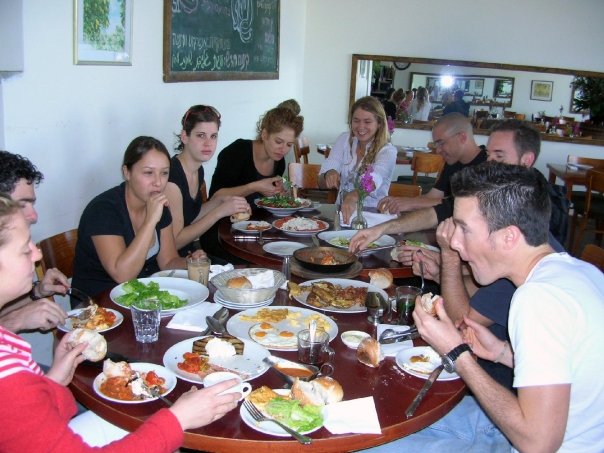
Breakfast at Gilly's (that's me at the head of the table)


The first word out of my mouth every day is in Hebrew, and the last thing I say before I got to bed is "layla tov" (good night). I've begun to resent Americans who speak English here.  They don't understand the raw
beauty of the Hebrew language.

Last night, while out celebrating my new civil status with a couple pints of beer, my friend noted how different one's voice sounds when speaking Hebrew as opposed to English.  He then pointed to his heart and he said, "Hebrew comes from here".  "English", he said, pointing to his head, "English comes from here".  

And he's right. In Hebrew, there's no other option but to speak the truth.  Hebrew doesn't allow for anything but brutal honesty.  In English, everything is softer, more polite, and takes longer to say; everything is somehow
twisted, and a bit less exact.

Compared to Hebrew, the English-speaking world is a play, a farce, or a choreographed dance of sorts.  If Spanish is a strange magical dream, and French is the language of romance; if Chinese is complex and somewhat mathematical, and Russian is the slurred speech of alcoholism; Hebrew is the language of raw, direct, honest truth.

So maybe that's it. Maybe that's why there are cigarettes scattered along every sidewalk, and why the paint is peeling on almost every building.  Maybe that's why there was grayness and uncomfortable metal chairs and half-smiles yesterday morning.  Maybe that's why I didn't feel any different at all. 

This piece of paper, this small photo-ID, this morning free of ceremony- it all said more than I had realized. It's honest. It's not very polite. It's not sugar coated. There's no celebration, no gifts or kitschy fake smiles. The ID is as plain as plain can be.  It says what needs to be said, and no more. Without a hologram or a laminated seal, it says that I am now a person whose name and birthday and residence are printed … in Hebrew."


My Israeli ID Card


Monday, August 2, 2010

Carmel Market in Tel Aviv

Some shots I dug up of the Carmel Market in the springtime. I always loved the juxtaposition of fresh produce, with the trash on the floor and the cigarette smoke fuming from the mouths of the fruit and vegetable vendors. It seems to me the perfect embodiment of Tel Aviv- a mess of beauty and freshness with ugly disrepair and bad habits.

Lettuce Stand
The marketplace culture in Israel is one of the things I really cherish.  The food is fresh and cheap, there is marketplace banter with locals, you find yourself connecting with vendors and returning to them each week, and the smell is a mix of spices, fresh juice, body odor, smoke and sunshine.


Picking Peppers 
 You're on your own in the market.  You push your way through throngs of people pulling carts behind them, ask for prices, and you can bargain, although not all do.
Sometimes you can find beauty in decomposition
 Watch your step especially at the end of the day.  The floor of the marketplace is bound to be covered in mounds of rotting produce, cardboard boxes, plastic bags, and cigarette stubs.  In the Tikvah Market, a massive bulldozer comes through the long pathway at the end of the street to clean out the trash every evening at 8pm.
Vegetable Vendor

Written across the box: "Choice Tomatoes" 
Rays of light brighten every item, but they don't need to be sold.  The produce in Israel is among the tastiest I've ever tasted.  I will never forget when I came to visit Israel with my family when I was 12.  The tomatoes! Oh they were so sweet and juicy. Perfectly firm, and just the right size. When we returned home, I couldn't bring myself to take one bite of those giant colorless tomatoes that find their way into nearly every "house salad".

Sweet Potatoes
 I never likes sweet potatoes till I moved here.  Now I love them. Maybe its maturity.  Maybe its just that they taste better here.  Oh- and no one cooks them with marshmallows. Yeah- whoever thought that that would be a good idea should be shot.

An oil painting of mine inspired by Israel

Sunday, August 1, 2010

The Israeli Way: favors that aren't quite favors

This weekend I went with my boyfriend, Yotam, and a number of friends to spend a night on a beach south of Tel Aviv.  These weekends aren't all that infrequent.  They usually consist of a BBQ (Israelis love their BBQing and have a habit of setting up a fire with a metal grill wherever whenever) and drinking with some intermittent swimming.
Typical Israeli BBQ, aka על האש

What is always unique about these events is the way that everyone pitches in.  Someone volunteers to drive (most people don't have cars) someone volunteers to buy meat, another beer, another chips and so on.  If someone doesn't have a car, the group makes calls to friends that don't mind lending them one.  If someone doesn't have a grill- the same.  The notion that it's impolite to ask, doesn't exist.

Let me clarify.

Our beach weekend began at Kibbutz Palmachin, a kibbutz right on the beach. An old friend of one of our buddies named Noam happens to live there in a beautiful house with a lawn and a view of the ocean (both of these are very rare).
Kibbutz Palmachim

It was not question: Of course the eight of us could come and use his house and his yard and his kitchen for our BBQ.  We were welcome to whatever.

We showed up with all our shit at dusk (never mind the constant phone calls back and forth as we got lost and needed clearer directions to his place) and threw 30 beers in Noam's freezer and fridge.  We threw the rest of our food in his kitchen while he and his girlfriend got ready to leave for a family dinner.  Before we went for a short walk on the beach, he left us his key and told us to have fun. And that was that.

The eight of us took a stroll, came back and set up Noam's grill.

We used his coals, some of his spices, paper cups, plates and knives. Three hours were spent in his front yard drinking, cooking, eating while he was away.  Neighbors of his walked by.  "You want to eat?" we asked. "Come, have something to eat. Come."  When we needed a candle, we just knocked on the door of the nearest house.  They brought us one with a smile.

When Noam and his girlfriend returned they happily sat with us, despite the fact that they knew only about 2/8ths of us and we returned the key. We sat together, drank together, and then cleaned up.  We said our goodbyes, invited them to come meet us at the beach for some fun and games before bed, and that was that.

Would this EVER happen in the states?!

Palmachim Beach, where we slept

Tel Aviv Vs. Jerusalem

There has been a lot of debate among the young 20-30 somethings about which city is queen. To be fair, the debate reacher far past the highschool halls of sixteen year olds in the scouts and even beyond the cocktail hours of our beloved elders. Statistics even have a say here, making their mark in what appears to be a huge decline in young singles and a massive increase in religious numbers of all walks of life: international othrodox, cnservatives and even reform jews making aliyah as well as the infinite number of children being bornto religious Jewish family units.

But, when it comes down to it...why would a young, free thinking Israeli choose to live in one city or the other?

Here I'll lay out the basic qualities that both draw and detract visitors from both cities.

Jeruslaem:
  • History: this is the first place for Jews and non-Jews to feel holy in face of and despite religious differences. This is the city most religious Jews flock to because of its connection to the Jewish past and the bible. It is also the city that most religious non-Jews flock to for very similar reasons. There is somehing special about the old city and the fact that it you still feel like you're traveling back in time when you walk through the gates and wander around the city and through the marketplaces.

    Old City of Jerusalem
  • Universities: There are at least two really wonderful universities in Jerusalem which draw most of the young secular Israelis to the city: Hebrew University and Bezalel Academy of Arts and Design. Both are thought to be top rate academic institutions- Bezalel being considered the top art school in all of Israel.

    Hebrew University Campus in Winter
  • Diversity: Because the city draws people from all over the world including journalists and politicians (Jerusalem is also the country's capital) there is a certian kind of diversity. While this usually isn't political diversity (most residents lean to the right, if not very far right) it is racial, ethnic and international diversity. However, sometimes it can be annoying that so many people speak only English. You can pretty much get by in Jerusalem without learning any Hebrew.
  • Less Materialism: While there is a brand new high-end mall that was built right outside of the old city to lure tourists, there is not really a materialistic feel in Jerusalem. There's far less of the "seen and be seen" culture, not as much of a cafe culture, and the pick-up bar scene is pretty moderate. This makes the interaction between people, especially among young, secular Israelis, very warm and friendly. No one is judging, people are very open, and typically they are also quite easygoing.
  • Weather: It's no coincidence that one of the famous lines of "Jerusalem of Gold" translates as "mountain air clear as wine and the smell of oranim flowers". This is the truth. The air is clear, mountain air, low humidity, with very beautiful hills and gorgeous foliage. They also get a fair ammount of rain, the winters are cool and actually feel like winter. However, this means that wintertime can get pretty depressing, cold and grey since Israel's archatecture isn't really built for cold weather.

    Snow in Jerusalem, 2008
  • Danger: Jerusalem is a target and it is right next to Arab villages filled with Arabs who aren't very happy about Israel's existance. This, mixed with the fact that numerous fundamental religious Jews who hate Arabs also live in close proximity, make it a very tense place. It's all about control really- I mean, I'd say that reform and conservative Jews also don't feel 100% comfortable there- being that there is such strong stigma against their customs and ways in this holy city.
Tel Aviv:
  • Beach!!!! This is a beach city. It's filled with leafy avenues, and the summer welcomes packed beaches, bikinis, icecream trucks and the smell of suntan lotion. This is one of the reasons that people here look so fit. They are always in shape becuase bikini season is every season.
  • Tel Aviv Beach
  • Young and Vibrant: Tel Aviv is filled with young people. Young people that are working hard to live there because they think it's fabulous and they want to be part of that fabulousness. People go out to eat and drink a lot. There are great restaurants, concerts, and events. There is a big pick-up-bar scene and lots of gay bars. Fashion and style is way more important and there is definitely a cafe lifestyle here. There's even a dog-culture here of dog walkers and dog sitters - very nyc.
  • Unique Aesthetic: There is something unique about the Tel Aviv aesthetic. It is almost ugly. Most of the buildings aren't upkept, although more and more are being restored- especially the famous bouhaus specimens. This makes Tel Aviv a fascinating place to walk around. Each neighborhood has really defining characteristics. The beach definitely makes it beautiful, as do many of the central squares, but some are still poorly designed and leave much to be desired.

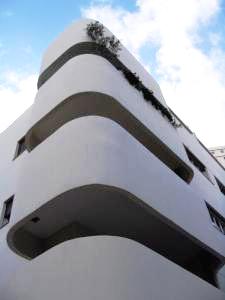
    Tel Aviv Bouhaus
  • Modern and Progressive...BUT: Tel Aviv is friendly to the progressive, liberal capitalist. But, it is still Israeli. It is NY without the suits, Miami without the rich, Buenos Aires without the history, and don't expect anything to be polite there. Getting on a bus is still a bit third world. It involves pushing and shoving and knowing where you are and where you want to get off. There is not really any info on the bus or at the stop. You have to ask people.
  • The Best Parties: If you are young and you like going out- If you want to see the most famous musicians from around the globe perform, if you want to go to cool new bars, if you want to see the best local musicians perform or have a taste of an all night trance party, tel aviv is the palce to be.
  • Jobs:It's not that there aren't jobs in Jerusalem, but there are just more in Tel Aviv. What can I say - it is a more modern, more international and more progressive city.
  • Yafo: It's part of the city, it's mostly Arab and it has the bext hummus places around. The port has been rennovated with new winde bars, restaurants, galleries and more, while the rougher neighborhoods have remained authentically rough.

Old Yafo Port

Monday, July 26, 2010

Valentines Day in Tel Aviv

Like every other holiday in Israel that tries to be commercial and follow in the footsteps of the USA, Tu B'Av is a complete bomb. Tu B'Av, meaning literally the 15th day of the month of Av, is also known as Hag Ha'Ahava (The Love Holiday). It's far calmer than Valentine's Day. Let's put it this way, no one brought chocolate to the office today and not one of my friends asked me where my boyfriend was taking me out to dinner tonight.

So, to show some love for a holiday that should be loved by all, here are a few romantic gestures.


Vintage Greetings Card

This vintage greeting card is both adorable and obscene. Who thought it was a good idea to draw a little boy pumping a large phallus dripping hearts next to a young girl? She looks like she either wants to dive into the pool below or like she's praying to God that she won't got to hell for this.

Beautifully Blossoming Bouquet

This bouquet is simply exquisite. Just looking at the picture makes me all warm inside. No, my boyfriend did NOT get my a bouquet that is this stunning. Should I tell him he is a naughty boy!?

So cute!

I absolutely love these little candies, despite the fact that they taste like chalk. But they just look so adorable in a glass bowl and they are definitely fun to have around when you're drinking.

Doodles of Love

I think my notebooks in 7th grade looked exactly like this!!! Except the pages probably had I *heart* Jared Leto scattered throughout the pink and red hearts.


Friday, July 23, 2010

Tel Aviv Nightlife Diluted!!!!

This week, the Knesset unanimously passed a bill outlawing the sale of alcohol between the hours of 11pm and 6am. Only restaurants and pubs will not be affected by the new legislation. The bill also includes a clause banning alcohol consumption in public during these hours. Once the law is enforced, police will be allowed to confiscate and pour out the contents of any open container being consumed in a public place.

No more beer after 11pm!

The law is intented to curb incidents of drunken violence which have been breaking out with more frequency in the past several years. More specifically, however, the concern of the Knesset members has been focused on the rising number of young drinkers aged 17 and below. According to statistics, Israel's rate of underage drinking has been going up for the past 20 years. Prime Minister Benjamin Netanyahu has called it "an epidemic".


However, according to a ynet article posted this past November, alcohol is not really a problem among adults:


"In Israel the problem isn’t grave in respect to the adult population,. There are no accurate figures about alcohol consumption, but based on various data, the annual per capita consumption is roughly about 2 liters (based on 100% alcohol consumption); the alcoholics’ rate is less the 0.5%, and “only” 2% of car accidents are attributed to driving under the influence."


And so, it is clear to me that the Knesset is going about the problem in the wrong way. Make it a requirement for stores to acquire alcohol licenses and be subject to audits and police supervision. But banning alcohol consumption in public areas, especially in a hot country like Israel where not everyone has air conditioning and drinking outdoors is part of the culture, is like banning fun altogether.
Florentine in Southern Tel Aviv: famous for it's street parties


Let me put it this way: my rights as a citizen are being restricted due to poor budgetary decision-making. If course I believe that it is important to combat street violence and of course I don't condone underage drinking, especially if it is over-drinking. I also am aware of the rising number of car accidents cause by drunk driving in the Jewish State. But these accidents, violent incidents and statistics are correlated with poor education systems in Israeli suburbs, poor governmental support systems for low-income families, and poor public transportation at night.


The new bill will cost the government 27 million shekels which, in my opinion, should not be going towards an alcohol ban, but rather,should be going to education, social reform and public transport.


Why should I have to give up my right to buy a beer at a kiosk after 11:00pm for 7 shekels and be forced to drink at a bar or restaurant and pay 25 shekels? No more Tel Aviv street parties, beach parties or avenue gatherings. No more sauntering down Rothschild boulevard with a beer in hand after 12:00 midnight. And what will happen to our beloved weekly drinking game that we play outside of my friend Kristal's kiosk? Will our beers be confiscated and our weekly event be put to an end? What will happen to Tel Aviv nightlife?
No more beer on the beach after dark


Why should I have to fear policemen at night when I'm a responsible drinker who is only trying to save herself a few shekels buy buying a beer at a kiosk and drinking it outside in the fresh air as opposed to inside where I can't afford air conditioning!?


Monday, July 5, 2010

Just When I thought Israeli's had totally given up on reading....

Book Week
Yes, I know that the first week in June was "Book Week" (שבוע הספר) but, really, in Israel, all that means is crazy discounts on books in one of their two bookstore chains: Stiematsky and Tzomet Sfarim (Translation: book juction). There were no events in libraries, nothing too special on TV. In short, it was more commercial than anything else. Just because people buy lots of books, it doesn't mean they read them.

Why am I telling you this? Because I was already certain that Israel had completely lost interest in investing in books, libraries and education.

Tel Aviv University Library
I mean, the best library in Tel Aviv is the Tel Aviv University library,which I have to say is pretty crappy. but compared to the other libraries, which, I'd say most people haven't even heard of, it's the best.

If it is the best library in Tel Aviv, what could be so bad about it, you might ask?

First of all, in order to even use the library, you have to be a student with a student card. Secondly, even if you are a student, you aren't allowed in with a bag. Now this shouldn't be all that problematic, considering there are a number of locker-stalls down stairs. However, the locker stalls can only be operated with the insertion of a ten shekel coin. And no one ever seems to have a ten shekel coin on them. Of course, there are no change machines in the library lobby. You either have to buy a snack or beverage with a large bill (neither of which you are allowed to bring INTO the library to eat or drink) or you have to exit the library and find someone nice to change your bills.

When you finally get all of this done with, you have to figure out how to use their ridiculously complicated catalogue which makes it very clear how disorganized their books are. Their numbers make no sense. Books in the 140s are near 900.3. Books that are 800-830 are on one floor, but 830-850 are on another floor. And finally 850-900 are across the hall. You can't seem to be able to find anything.

The worst part about it is that most books are out. Those that aren't out are scattered around the library somewhere other than where they are supposed to be.

Also, the selection isn't THAT amazing. There are many books that you would expect a library to have that thy simply don't have. Plus, there are hardly any children's books. Movies and DVDs are out of the question as are interesting magazines.

And Yet!

Literary Corner in Tel Aviv Slum
Haaretz just posted an article about a group of artists and activists called ARTEAM that have put together an outdoor artinstallation/library in one of the dirtiest parks in Tel Aviv. Levinsky park is right next to the new bus station, so you can just imagine how serene the surroundings are with buses and service taxis rushing by every few seconds. Plus, the area is completely neglected by the municipality. Most of the time, the park is filled with benign migrant workers intermingled with drunkards, homeless, drug addicts, drug dealers and your neighborhood pimps.

According to Haaretz, the team catered to the multicultural community, looking for books in all different languages, including Turkish, Arabic and Nepali.

Are They Serious!?
My question is, do they really think this is going to do ANYTHING? I mean, how long do they think the books will be there before everyone comes and steals them and then goes and sells them in the Yafo flea market? There needs to be infrastructure to programs like this. The whole art-installation library thing is a nice idea and I'm sure it made the ARTEAM volunteers feel good, like they did a good deed and made an effort to raise awareness about an impoverished community, but it is clear to me that this will not last.


What do you think? Comments?

The Slums of Tel Aviv

Not everyone knows about them, but there are definitely slums in Tel Aviv. That's not to say that the entire city doesn't look a bit slummy sometimes, but there are certain areas that are significantly slummier than others. I've lived in nearly all of them. I've decided to categorize the top five slums in Tel Aviv according to the following criteria:

1) Ability to walk down street without men whistling at me
2) Ability to walk down street without cars stopping, mistaking me for a whore
3) Ability to walk down street without tripping over a drunk homeless person
4) Number of languages spoken in neighborhood that aren't Hebrew
5) Smelliness of trash +food
6) Number of shouting matches that occur during the course of 24 hours
7) Number of violent fights that break out on the street
8) Number of cats
9) Number of old ladies who feed the cats
10) Total number of friends who will not give me a ride home because they are scared of driving through the neighborhood.

After doing some rough calculations.....drum roll please.... I present you with:

Tel Aviv's Top Ten Slums!!!!
10)Neve Gan: Ok, to be quite honest with you, I really don't know anything about this area. But this guy that I work with keeps telling me how run down it is, so I'm just going to have to believe him.
9)Neve Sharet: Um, yea. Ditto.
8) Givat Hertzel: too industrial to be a slum, really, but it sits right in between three big slums- so let's just say it's a slum crossing.
7) Florentine: it's dirty and there's shit and drug addicts everywhere, but somehow it's also chic!
6) Shapira: Lots of drunk old men with no teeth, and plenty of fat, old prostitutes.
5) Neve Sha'an: The red light district of tel aviv, with some multicultural flair. The whole area smells like a mix of curry and b.o.
4) Hatikvah: high crime rate, poor families, plenty of police patrol and way way too many stray animals.
3) Yafo Alef: Just moving into Yafo. Fewer old ladies feeding cats. More old men smoking cigarettes and being nasty.
2)Schunay Chisachon: Industrial.
1)Ajami: I mean, they made a freakin movie about it. And that movie scared the crap out of me.