Header Photo Credit

*The stunning photo in the header of my blog is all thanks to Ron Shoshani. Visit his facebook page for more of his amazing photographs of Tel Aviv!
Showing posts with label Israeli food. Show all posts

Wednesday, November 3, 2010

My Love Affair with a Pomegranate

Follow my blog with bloglovin

It’s the height of pomegranate season in Israel.  A walk through any shuk (שוק-market place) and you’ll catch a glimpse of the extraordinary bulbous fruit at nearly every produce stand.  It’s deep, earthy smell of soury sweetness is in the air.  And so, I dedicate this post to the pomegranate- a fruit that has tantalized the hearts of man for thousands of years. 

The pomegranate is an ancient fruit, and holds symbolic meaning which many believe to have been the true forbidden fruit in the garden of Eden.  Pomegranates were also one of the first fruits brought back to Moses as proof that the Promised Land was really as good God told Moses it would be:

For the LORD thy God bringeth thee into a good land, a land of brooks of water, of fountains and depths that spring out of valleys and hills; A land of wheat, and barley, and vines, and fig trees, and pomegranates; a land of oil olive, and honey; A land wherein thou shalt eat bread without scarceness, thou shalt not lack any thing in it; a land whose stones are iron, and out of whose hills thou mayest dig brass” Deuteronomy 8:6-14

The fruit is mentioned frequently in the Bible, typically in connection with beauty, love, romance, and bounty.

Photo Credit:(clockwise)Painting by IlseKlyn, photo by Graur Codrin, painting by CraigStephens

Native to the Mediterranean, specifically eastern Iran, the fruit made its way to other areas of the Mediterranean and Asia with the help of Greek and Roman trade. Many Greek myths feature the pomegranates as symbols of fertility, royalty, power or sinfulness, and the exotic crown-shaped fruit has been absorbed into nearly every major culture today including Chinese, Islam, Christianity and Hindu. 

Not only are pomegranates exquisite in form and precious to countless religions and cultures, but they are also terrificly tasty.  Throw some pomegranate seeds in a salad and you've added a sweet crunch thats to die for. Mix up some pomegranate juice with apple and pear juice, and add yogurt if you like for a smooth fruit drink.  Place a chicken in the oven and cover it with pomegranate seeds and lemon essence for a sweetly sour delectable dish. The recipes are endless.


If you're looking for a unique Israeli take on the pomegranate, pick up a Rimon Wine - they are a winery that makes their wines entirely from expertly fermented pomegranate juice. Their winery is in the stunning Upper Galilee Region of Israel, which, if you plan to travel in Israel, you should find time for wine and pomegranates aside.  I've tasted their wines a number of times and have been pleasantly surprised.  They're sweet, but not too sweet: a nice port-substitute and a perfect garnish for a warm pound cake or bowl of vanilla ice cream.


Of course, with such a rich relationship with man, the name, pomegranate, also has an interesting story.  "Punica Granadum" is the official genus name, named after the Phoenicias who, with their advanced seafaring, greatly contributed to the spread of it's cultivation. The Latin "pomum" (apple) and "granatus" (seeds) influenced the fruit's name in many Romance Languages. In English, the pomegranate was first recorded as being called "The Apple of Granada", which is thought to be  attributed to a mis-transaltion of the French "pome-grenade".  The Hebrew, "rimon" (רימון), almost identical in Aabic, "romman, or rumman" (رمان) is also used to refer to a grenade or shell.  


Despite the pomegranates Middle Eastern heritage and mythical reputation, today the fruit is widely known for its incomparable health benefits. As it turns out, the fruit isn't just sweet and crunchy, it's also rich in vitamins A, B, C, iron, calcium, potassium and more.  According to recent studies, it neutralizes free radicals in the human body faster than red wine or green tea, meaning it may help prevent cancer, and has also been found to help treat those suffering from high blood pressure! 

So, now I revel in the perfection of the pomegranate season in Israel.  And, of course, living next to an open air Tel Aviv market where the fruit is fresh and fragrant isn't too bad either!  


Saturday, October 30, 2010

Recipe: The Perfect Pita

Another one of my friends, Roni, turned 30 last weekend (yep- another one) and to celebrate, a group of us friends and most of his family family somehow managed to lure him to a surprise camping adventure in Beit Hananya near Ceasarea.  It was a near perfect surprise....and it's always fun to jump out at someone from behind the bushes. 

Roni was thrilled, and we all enjoyed ourselves. There was music, food and festivities. |What made the entire event especially enjoyable was the high quality of the camp site. The camp grounds in Beit Hananya are the nicest I've seen in Israel: There was a shack with refrigerators open to public use, lights, electricity outlets, sinks, bathrooms and even showers. 

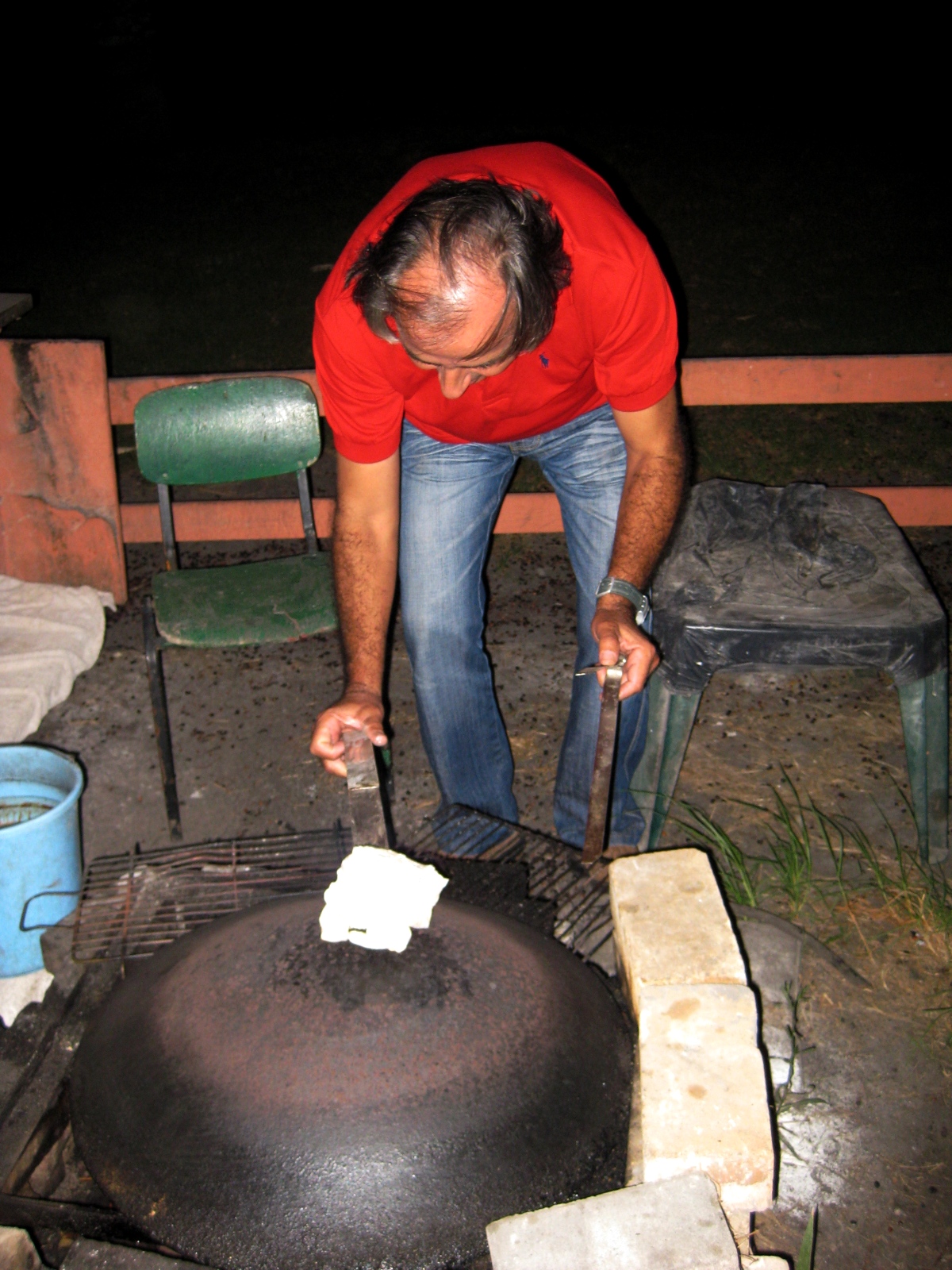
Aside from the fantastic facilities, Beit Hananya also offers activities to parties camping at their site. Our party of maybe 40 or more happily partook in pita making!
Here's a snapshot at how we made some plain dough into delicious pitot.

Ingredients:
3 Cups of All Purpose Flour (we used white flour but you can mix it up with wheat flour too.)
2 Teaspoons instant yeast 
2 Teaspoons Kosher Salt (regular salt is fine, 
1 Teaspoon sugar (or honey)
3 Tablespoon Extra Virgin Olive Oil
1 1/4-1/12 cups of warm water (not too warm, room temperature is good)

Preparation:
Place all the dry ingredients into a bowl, mix, and then add the olive oil and 1 1/4 cups of water.  Stir mixture well till it turns into a big lump of dough, or in Hebrew, a "gush batzek" (גוש בצק).  Then knead knead and knead.  You'll have to do this for about 5-10 minutes.  Knead till the dough is sticky, but not dry, and all the flour sticks to the lump.  If it doesn't add more water and knead a bit more.

Once the lump of dough looks good, place it in a greased bowl, cover the bowl, and let the dough sit for about 2 hours.  The dough should double in size. It should also be a bit stickier than before. 

Now coat your hands with flour, dust the dough ball with flour and dust your working surface with flour.  You're now ready to start making pita doughballs! 

Roni works the dough into dough balls

Notice the iphone.  It has nothing to do with making pitas.


Roni gets moral support from friends and family.
 Apparently dough-ball making can make  you feel like less of a man. I had no idea. 

Dough-ball making is so easy, even little people can do it. 


Now, once you have your dough into a nicely sized ball, you must flatten it.  You can do this in a variety of ways. 
1. With a stick that acts as a rolling pin

(don't forget to dust the ball, stick and surface with flour)


2. Pat it flat in your hands
Nice and patted
3. Or you can roll it with a stick on your hand.
As you can see from the picture above, Roni prefers this method,
although it's by far the least practical. 
Now, the traditional way of making flat pitas Bedouin-style is to cook them quickly on a large heated pan.  If you're making pitas at home, you can either bake your pitas in the oven, or you can fry them on a skillet.

Baked Pitas:
Preheat the oven to 400 degrees (let the flattened dough sit for about 15 minutes while you do this) and then place your flattened dough-balls on a cookie sheet or pizza stone.  Bake for 5 minutes max for soft, fluffy pitas.  Remove and let cool.  Then eat! yum!

Fried Pitas:
Coat your skillet (frying pan, whatever) with a very light coating of olive oil.  These come out chewy, and I think they taste the best when the dough is especially flat.  Place the flattened dough-balls in the skillet for 1-2 minutes on either side so that each side is seared by the pan. Then remove and eat!

Bedouin Style:
Build a fire beneath a large metal pan.  Once the entire pan is heated, coat it in a bit of olive oil and start cooking.  Place the flattened pita dough-balls on the large pan and sear either side of the bread.  If the pan is sufficiently hot, and the dough sufficiently flat, the pita should cook for less than 1 minute per side.  Our pitas took a bit longer since out flattening methods were not the most efficient.


A nice garnish is Zaatar in Olive Oil, T'china, Hummus or Labane cheese (soft soury cheese). If you can get your hands on Zaatar, a staple Middle Eastern spice, I definitely recommend it with a fresh pita. 

Here I am below, enjoying a fresh pita with a garnish of Zaatar in Olive Oil. 

Zaatar in Olive Oil

Tasty bread!


Friday, August 6, 2010

Israeli Wine Festival Intoxicates Jerusalem

Yesterday was the third and last night of the Israeli wine festival held at the newly rennovated Israel Museum in Jerusalem. An admissions fee of 60 shekels got me a high quality wine glass and free drinks all night from some of the best wineries in the country. 

The festival, featuring a live jazz band (which was fantastic this year), sushi bars, chocolate stands and French cheese platters served with warm bread, has been a success for years now, and has grown bigger and more popular over the years.  I don't see what's not to like.  An evening of wine tasting, good music and organized public drunkeness for 60 shekels...plus I get to keep the glass? It's a no brainer.

This was my second year at the festival which draws visitors and wineries from all over the country. The vineyeards set up beautiful stands outdoors, the bigger Israeli wineries setting up what look like small, airy wine bars, stocked with young bardudes and barchics outfitted in black collard shirts and ties ready to spew out every detail about the wine you are tasting.

The old cultured folk who actually care about the Israeli wine they are drinking and wander around with pen in hand making notes about each bottle are typically over 50, arrive early, and dress well.  By the time 10:00 rolls around, the mayhem begins welcoming throngs of kids who don't know and don't care what you pour into their cups- they'll drink it and they'll ask for more.  They come for a good deal on an evening of all night open bar and leave shit-faced.

Last year, Yotam and I arrived around 9-ish and stayed till it closed at 11:00pm.  We left with over 4 wine glasses each- glasses that had been abandoned or forgotten by careless tasters- and awoke the next morning with massive hangovers. But it was worth it. With our sneaky glass lifting, we had moved up in the world; we no longer drink our wine out of coffee mugs and plastic cups.

This year, Yotam and I arrived at 7:00pm sharp just as the doors were opening and dusk settled over the city.  We left early too: by 10:00pm the place was packed and wineries were running out of wine.  The hangover hit us just as hard.

Both last year and this year, the wine festival saw a huge number of young, Modern Orthodox American Jews. Huge.  Each winery was well-prepared with at least one native English speaker behind each counter to field the questions from inquisitive Shwartzes, Rosenbergs and Cohens.  I felt like I was at Brandeis University.  It was a sea of heads topped with suede yarmulkas. I hadn't seen so many untucked pastel colored cotton polos in one place since I visited my high school friends in Baltimore in 2003.

Aside from the stampede of American Jews, the evening was fantastic.  Some of the wines were especially tasty, and the Jerusalem weather was refreshingly breezy. 

Here are my favorite wine picks (no, sadly I'm not getting paid for these reccomendations, but maybe if you click on their links and they notice the traffic, they'll find me and send me some free bottles):

Tzuba 2006 Metzuda
75% Cabernet Sauvignon, 20% Cabernet Franc and 5% Malbec.
Tzuba Winery is made in Kibbutz Tzuba, located in the Judean hills right outside of Jerusalem. This blend is smooth and aromatic, with a bit of a fruity aftertaste.

Teperberg 2007 Sangiovese Silver
A light, young red that is perfect for the summer, easy to drink and smooth going down.

Pelter 2007 Cabarnet Sauvignon
I really don't like judging wines from the lables, but really, Peter's lable design is classy, pretty and clean.  So is their website. I can't compare this wine to their others since they'd run out of everything but the Cabarnet by the time we got to their stand, but this was a real winner and I'm usually not a Cabarnet girl.  It's rich with fruity and oaky flavors and a nice after-bite.

Rimon Wines

I'm not going to pick one, since they only had three to taste from - one desert wine, one  dry wine and one sweet port wine.  All of their wines are made entirely from pomegranites- no grapes are used at all- which makes them unique and interesting, although very sweet. Theirs are special occasion wines that I imagine go well with a platter of chocolate covered strawberries or bananas and cream.

[fyi: I'm leaving out a fantastic dry Riesling and a wonderful fruity wine blend of four wines which I'll update once I'm home with the details of each in front of me. ]

The Segal wines were especially dissappointing as were the Recanate reds, Yarden and Gamla Chardones from Ramat HaGolan, and the Binyamina Rose which fell very very flat.

Here are some pictures of this year's and last year's festival, courtesy of walla.co.il, mouse.co.il and gojerusalem.com.

View from above, near the jazz and food

Visitors are free to taste as many wines as they like

This picture is from the 2005 festival, but I had to post it. How awesome is that shirt?!

Israeli Wine looking sexy
Posted by Picasa

Wednesday, August 4, 2010

Making Aliyah in Tel Aviv- A Glance Back at My First Day as an Israeli Citizen

In light of my most recent post about marriage in Israel, I dug out my ruminations that I sent out to friends and family when I first made Aliyah...way back when I had long hair.

My relationship with Israel is a complicated affair.  You could call it a love/hate relationship, but it's more complicated than that. I think it comes down to the fact that we're both still trying to find ourselves.

Some of you have already read this.  Think of it as a nice refresher. Plus, I edited it a bit so that it reads a bit better.

 My love for this country and my fascination with Israel runs deep, despite the fact that I don't agree with everything that happens here.

Me and my brother in Israel 1995 (gotta love the hats)

"Yesterday morning, it was my turn. After waiting in a large gray hallway lined with uncomfortable gray metal chairs, it was finally my turn.  I'd watched for almost an hour as Russians, Koreans, Vietnamese, French,Spaniards, and Ethiopians jumped up at the call of their mispronounced name and entered the room behind the security guard with a thick Russian accent. 

Now it was my turn. I sat down at a big gray desk and handed over my birth certificate,  a letter from my rabbi confirming my maternal Jewish lineage, and my passport to a thin olive-skinned woman. I bit my nails and tried my best not to look to hung over.

Yesterday morning, a thin olive-skinned woman behind a big gray desk typed a few keys into her computer, made a few photocopies, and suddenly I was an Israeli citizen.  She handed me a small plastic folder with an ID card inside.  "Mazal Tov" she said with a half smile, and then she sent me on my way. She pressed a button to signal that her desk was open to serve the next in a long line of anxious people, and then she turned back to face her computer.

Yesterday morning I walked out of The Office of the Interior in Tel Aviv with my new ID card unsure of what to do next. For some reason, I thought I'd suddenly feel different.  Or, maybe not even feel different, but be different. Or if not that, even, I'd imagined that the staff at the office of the interior might hand me a small plastic Israeli flag, or a bag of
Bamba (Israeli snack food), or the words to the Israeli national anthem, 'HaTikvah', to welcome me as a new citizen of their holy country; to make me feel like this day was somehow special.

But there was none of that -- only a small piece of paper with my photograph and my name and birthday written in Hebrew. So, that's all my citizenship really is? A piece of paper? I came home feeling strange.  The day was incredibly anti-climactic.

At home I discussed my new status with my roommate Liron.  It didn't seem any different than any other conversation we have on any other day.  We sat on the balcony, drank coffee, smoked our cigarettes, and
spoke about little things and big things….in Hebrew.  I've already been living in Israel for over a year.  I already conduct my entire day in Hebrew.

My typical day is already quite "Israeli".  I sit on my mirpeset and drink my instant coffee before walking to work.  I walk the entire length of Tel Aviv at least twice a day, each day changing up the route depending on the weather. When it's too hot, I choose Ben Yehuda Street, which always has shade.  When it's too windy, I choose Dizengoff Street  which shelters from the sea breeze.  When the weather is just right, I walk along the boardwalk and sometimes allow myself a few meters of strolling along the shore. Every so often, I run the 4-kilometer length and shower at the public bathrooms near the Tel Aviv port where I work. 

Walking along the beach is by far my favorite route. I put on my ipod and stroll briskly down King George Street past its discount clothing stores.  I take a right on Allenby at the intersection where the Tel Aviv open-air market makes it's home.  I then pull a left on Ge'ulah, pass a few hotels and finally reach the boardwalk.


Me on the Tel Aviv beach with my friend Nomes
The Tel Aviv beach could never be mistaken for anything but a public beach.  The sand is laden with trash and cigarette butts, there are old men with dark shriveled skin playing Matcot (Paddle ball), and men and women of
all ages walking their dogs along the shoreline.  There are bike riders and runners, and kids playing volleyball.  There are homeless people sleeping on the hot sidewalks, and restaurants with tables in the sand where tourists watch the soft blue waves of the Mediterranean ebb and flow as they eat their Israeli breakfast of eggs, sour
cheese, and cucumber and tomato salad with lemon and olive oil. There are stands of jewelry sellers, portrait artists, and "born again" Orthodox Jews hoping to convert the secular.

One of the reasons that I love Tel Aviv is that it's a bit tacky. Maybe tacky isn't the right word.  Maybe the aesthetics just aren't 'polite'. While the city itself is beautiful and the sea is gorgeous, while most buildings betray their distinctive Bauhaus design and produce stands fill the streets with sweet smells and bright colors,
there is an air of disrepair hanging over Tel Aviv that can't be overlooked.  

Most buildings, even the most beautiful, have paint peeling at each corner of their balconies, and they aren't shy about their water stains or ashamed of their dirt-caked faces.  Most fruit vendors sit in the doorway of their healthy-looking stores, smoking cigarette after cigarette between deep phlegmy coughs.  And even the most important businessmen walk to work in shorts and a button-down linen shirt. Only recently have they implemented the "no jeans policy" in the Knesset. It's as if aesthetics are understood and important, but not important enough. And I take this all in as I walk my hour-long walk to Gilly's restaurant where I work as a hostess.

By the time I get to work, I'm almost always sweaty, and I'm ready for another shot of caffeine. I say 'boker tov' (good morning) to the barman, ask him to make me a cup of black coffee, log myself into the computer, and begin
answering phone calls.  At 9:30am all the waiters and waitresses working the first morning shift sit down to eat breakfast and chat about this and that before the restaurant opens at 10:00. I sit at the table, spooning salad, labane, and shakshuka (Israeli breakfast dish of eggs cooked in a tomato-base) onto my plate, and listen
to their stories.

Breakfast at Gilly's (that's me at the head of the table)


The first word out of my mouth every day is in Hebrew, and the last thing I say before I got to bed is "layla tov" (good night). I've begun to resent Americans who speak English here.  They don't understand the raw
beauty of the Hebrew language.

Last night, while out celebrating my new civil status with a couple pints of beer, my friend noted how different one's voice sounds when speaking Hebrew as opposed to English.  He then pointed to his heart and he said, "Hebrew comes from here".  "English", he said, pointing to his head, "English comes from here".  

And he's right. In Hebrew, there's no other option but to speak the truth.  Hebrew doesn't allow for anything but brutal honesty.  In English, everything is softer, more polite, and takes longer to say; everything is somehow
twisted, and a bit less exact.

Compared to Hebrew, the English-speaking world is a play, a farce, or a choreographed dance of sorts.  If Spanish is a strange magical dream, and French is the language of romance; if Chinese is complex and somewhat mathematical, and Russian is the slurred speech of alcoholism; Hebrew is the language of raw, direct, honest truth.

So maybe that's it. Maybe that's why there are cigarettes scattered along every sidewalk, and why the paint is peeling on almost every building.  Maybe that's why there was grayness and uncomfortable metal chairs and half-smiles yesterday morning.  Maybe that's why I didn't feel any different at all. 

This piece of paper, this small photo-ID, this morning free of ceremony- it all said more than I had realized. It's honest. It's not very polite. It's not sugar coated. There's no celebration, no gifts or kitschy fake smiles. The ID is as plain as plain can be.  It says what needs to be said, and no more. Without a hologram or a laminated seal, it says that I am now a person whose name and birthday and residence are printed … in Hebrew."


My Israeli ID Card


Monday, August 2, 2010

Carmel Market in Tel Aviv

Some shots I dug up of the Carmel Market in the springtime. I always loved the juxtaposition of fresh produce, with the trash on the floor and the cigarette smoke fuming from the mouths of the fruit and vegetable vendors. It seems to me the perfect embodiment of Tel Aviv- a mess of beauty and freshness with ugly disrepair and bad habits.

Lettuce Stand
The marketplace culture in Israel is one of the things I really cherish.  The food is fresh and cheap, there is marketplace banter with locals, you find yourself connecting with vendors and returning to them each week, and the smell is a mix of spices, fresh juice, body odor, smoke and sunshine.


Picking Peppers 
 You're on your own in the market.  You push your way through throngs of people pulling carts behind them, ask for prices, and you can bargain, although not all do.
Sometimes you can find beauty in decomposition
 Watch your step especially at the end of the day.  The floor of the marketplace is bound to be covered in mounds of rotting produce, cardboard boxes, plastic bags, and cigarette stubs.  In the Tikvah Market, a massive bulldozer comes through the long pathway at the end of the street to clean out the trash every evening at 8pm.
Vegetable Vendor

Written across the box: "Choice Tomatoes" 
Rays of light brighten every item, but they don't need to be sold.  The produce in Israel is among the tastiest I've ever tasted.  I will never forget when I came to visit Israel with my family when I was 12.  The tomatoes! Oh they were so sweet and juicy. Perfectly firm, and just the right size. When we returned home, I couldn't bring myself to take one bite of those giant colorless tomatoes that find their way into nearly every "house salad".

Sweet Potatoes
 I never likes sweet potatoes till I moved here.  Now I love them. Maybe its maturity.  Maybe its just that they taste better here.  Oh- and no one cooks them with marshmallows. Yeah- whoever thought that that would be a good idea should be shot.

An oil painting of mine inspired by Israel