Header Photo Credit

*The stunning photo in the header of my blog is all thanks to Ron Shoshani. Visit his facebook page for more of his amazing photographs of Tel Aviv!
Showing posts with label Middle eastern food. Show all posts

Wednesday, November 3, 2010

My Love Affair with a Pomegranate

Follow my blog with bloglovin

It’s the height of pomegranate season in Israel.  A walk through any shuk (שוק-market place) and you’ll catch a glimpse of the extraordinary bulbous fruit at nearly every produce stand.  It’s deep, earthy smell of soury sweetness is in the air.  And so, I dedicate this post to the pomegranate- a fruit that has tantalized the hearts of man for thousands of years. 

The pomegranate is an ancient fruit, and holds symbolic meaning which many believe to have been the true forbidden fruit in the garden of Eden.  Pomegranates were also one of the first fruits brought back to Moses as proof that the Promised Land was really as good God told Moses it would be:

For the LORD thy God bringeth thee into a good land, a land of brooks of water, of fountains and depths that spring out of valleys and hills; A land of wheat, and barley, and vines, and fig trees, and pomegranates; a land of oil olive, and honey; A land wherein thou shalt eat bread without scarceness, thou shalt not lack any thing in it; a land whose stones are iron, and out of whose hills thou mayest dig brass” Deuteronomy 8:6-14

The fruit is mentioned frequently in the Bible, typically in connection with beauty, love, romance, and bounty.

Photo Credit:(clockwise)Painting by IlseKlyn, photo by Graur Codrin, painting by CraigStephens

Native to the Mediterranean, specifically eastern Iran, the fruit made its way to other areas of the Mediterranean and Asia with the help of Greek and Roman trade. Many Greek myths feature the pomegranates as symbols of fertility, royalty, power or sinfulness, and the exotic crown-shaped fruit has been absorbed into nearly every major culture today including Chinese, Islam, Christianity and Hindu. 

Not only are pomegranates exquisite in form and precious to countless religions and cultures, but they are also terrificly tasty.  Throw some pomegranate seeds in a salad and you've added a sweet crunch thats to die for. Mix up some pomegranate juice with apple and pear juice, and add yogurt if you like for a smooth fruit drink.  Place a chicken in the oven and cover it with pomegranate seeds and lemon essence for a sweetly sour delectable dish. The recipes are endless.


If you're looking for a unique Israeli take on the pomegranate, pick up a Rimon Wine - they are a winery that makes their wines entirely from expertly fermented pomegranate juice. Their winery is in the stunning Upper Galilee Region of Israel, which, if you plan to travel in Israel, you should find time for wine and pomegranates aside.  I've tasted their wines a number of times and have been pleasantly surprised.  They're sweet, but not too sweet: a nice port-substitute and a perfect garnish for a warm pound cake or bowl of vanilla ice cream.


Of course, with such a rich relationship with man, the name, pomegranate, also has an interesting story.  "Punica Granadum" is the official genus name, named after the Phoenicias who, with their advanced seafaring, greatly contributed to the spread of it's cultivation. The Latin "pomum" (apple) and "granatus" (seeds) influenced the fruit's name in many Romance Languages. In English, the pomegranate was first recorded as being called "The Apple of Granada", which is thought to be  attributed to a mis-transaltion of the French "pome-grenade".  The Hebrew, "rimon" (רימון), almost identical in Aabic, "romman, or rumman" (رمان) is also used to refer to a grenade or shell.  


Despite the pomegranates Middle Eastern heritage and mythical reputation, today the fruit is widely known for its incomparable health benefits. As it turns out, the fruit isn't just sweet and crunchy, it's also rich in vitamins A, B, C, iron, calcium, potassium and more.  According to recent studies, it neutralizes free radicals in the human body faster than red wine or green tea, meaning it may help prevent cancer, and has also been found to help treat those suffering from high blood pressure! 

So, now I revel in the perfection of the pomegranate season in Israel.  And, of course, living next to an open air Tel Aviv market where the fruit is fresh and fragrant isn't too bad either!  


Saturday, October 30, 2010

Recipe: The Perfect Pita

Another one of my friends, Roni, turned 30 last weekend (yep- another one) and to celebrate, a group of us friends and most of his family family somehow managed to lure him to a surprise camping adventure in Beit Hananya near Ceasarea.  It was a near perfect surprise....and it's always fun to jump out at someone from behind the bushes. 

Roni was thrilled, and we all enjoyed ourselves. There was music, food and festivities. |What made the entire event especially enjoyable was the high quality of the camp site. The camp grounds in Beit Hananya are the nicest I've seen in Israel: There was a shack with refrigerators open to public use, lights, electricity outlets, sinks, bathrooms and even showers. 

Aside from the fantastic facilities, Beit Hananya also offers activities to parties camping at their site. Our party of maybe 40 or more happily partook in pita making!
Here's a snapshot at how we made some plain dough into delicious pitot.

Ingredients:
3 Cups of All Purpose Flour (we used white flour but you can mix it up with wheat flour too.)
2 Teaspoons instant yeast 
2 Teaspoons Kosher Salt (regular salt is fine, 
1 Teaspoon sugar (or honey)
3 Tablespoon Extra Virgin Olive Oil
1 1/4-1/12 cups of warm water (not too warm, room temperature is good)

Preparation:
Place all the dry ingredients into a bowl, mix, and then add the olive oil and 1 1/4 cups of water.  Stir mixture well till it turns into a big lump of dough, or in Hebrew, a "gush batzek" (גוש בצק).  Then knead knead and knead.  You'll have to do this for about 5-10 minutes.  Knead till the dough is sticky, but not dry, and all the flour sticks to the lump.  If it doesn't add more water and knead a bit more.

Once the lump of dough looks good, place it in a greased bowl, cover the bowl, and let the dough sit for about 2 hours.  The dough should double in size. It should also be a bit stickier than before. 

Now coat your hands with flour, dust the dough ball with flour and dust your working surface with flour.  You're now ready to start making pita doughballs! 

Roni works the dough into dough balls

Notice the iphone.  It has nothing to do with making pitas.


Roni gets moral support from friends and family.
 Apparently dough-ball making can make  you feel like less of a man. I had no idea. 

Dough-ball making is so easy, even little people can do it. 


Now, once you have your dough into a nicely sized ball, you must flatten it.  You can do this in a variety of ways. 
1. With a stick that acts as a rolling pin

(don't forget to dust the ball, stick and surface with flour)


2. Pat it flat in your hands
Nice and patted
3. Or you can roll it with a stick on your hand.
As you can see from the picture above, Roni prefers this method,
although it's by far the least practical. 
Now, the traditional way of making flat pitas Bedouin-style is to cook them quickly on a large heated pan.  If you're making pitas at home, you can either bake your pitas in the oven, or you can fry them on a skillet.

Baked Pitas:
Preheat the oven to 400 degrees (let the flattened dough sit for about 15 minutes while you do this) and then place your flattened dough-balls on a cookie sheet or pizza stone.  Bake for 5 minutes max for soft, fluffy pitas.  Remove and let cool.  Then eat! yum!

Fried Pitas:
Coat your skillet (frying pan, whatever) with a very light coating of olive oil.  These come out chewy, and I think they taste the best when the dough is especially flat.  Place the flattened dough-balls in the skillet for 1-2 minutes on either side so that each side is seared by the pan. Then remove and eat!

Bedouin Style:
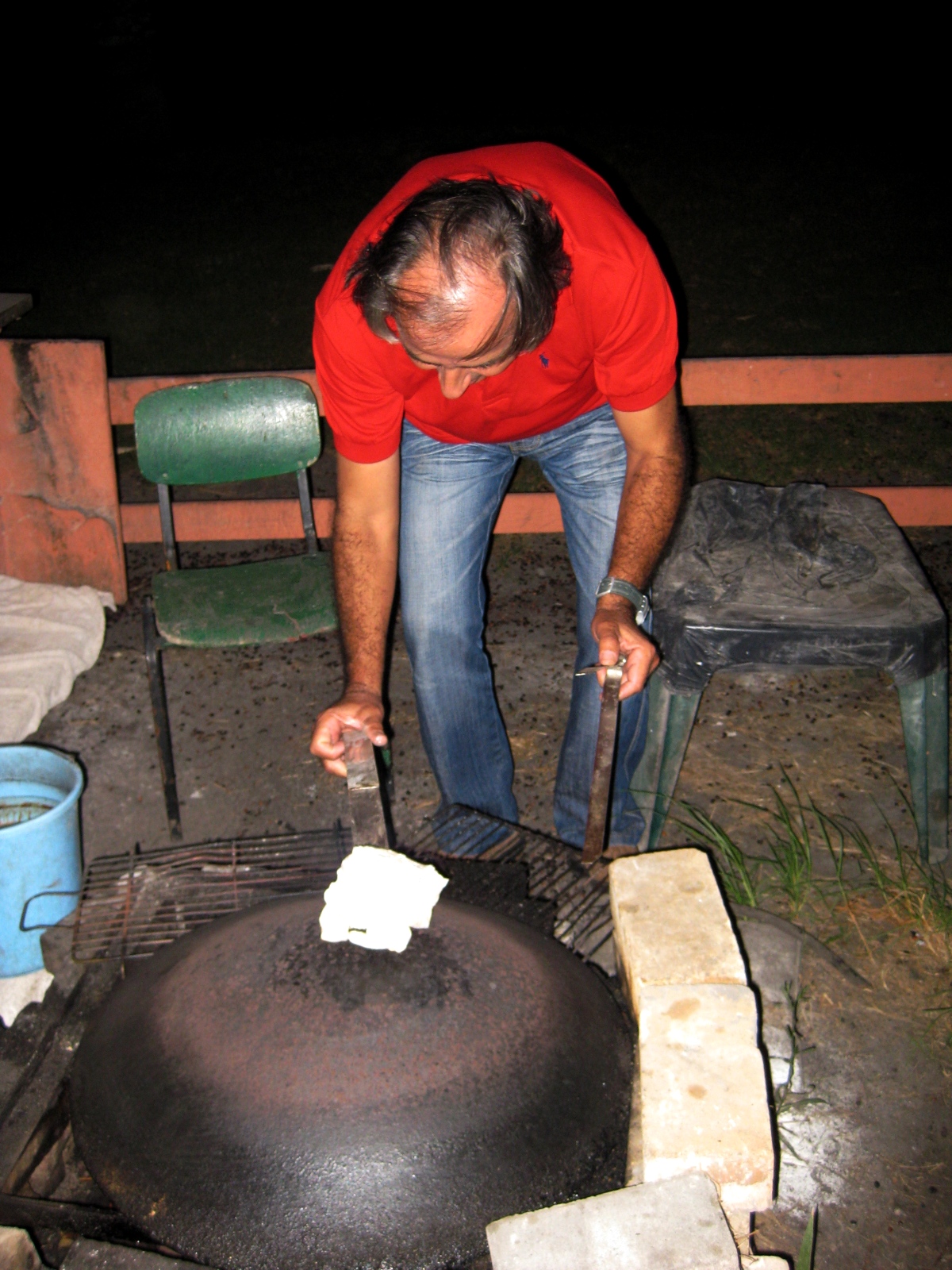
Build a fire beneath a large metal pan.  Once the entire pan is heated, coat it in a bit of olive oil and start cooking.  Place the flattened pita dough-balls on the large pan and sear either side of the bread.  If the pan is sufficiently hot, and the dough sufficiently flat, the pita should cook for less than 1 minute per side.  Our pitas took a bit longer since out flattening methods were not the most efficient.


A nice garnish is Zaatar in Olive Oil, T'china, Hummus or Labane cheese (soft soury cheese). If you can get your hands on Zaatar, a staple Middle Eastern spice, I definitely recommend it with a fresh pita. 

Here I am below, enjoying a fresh pita with a garnish of Zaatar in Olive Oil. 

Zaatar in Olive Oil

Tasty bread!