I know these things are always edited to showcase the dumbest of the dumb...but really?! I mean, seriously?
Watch this and you will feel smart.
These college kids must have killed all of their brain cells doing bong hits and keg stands at some crazy frat party.

Showing posts with label Middle East Peace Negotiations. Show all posts
Showing posts with label Middle East Peace Negotiations. Show all posts
Tuesday, January 4, 2011

Monday, January 3, 2011
Is Netanyahu a little boy or a parody of himself?
 |
| Photo Credit: Donkey Hotey |
I know what you're thinking: the gray hair, the wrinkles, the suit. But if you take a look at the way Israeli Prime Minister Benjamin Netanyahu interacts with the media, you might think he was a little boy. Either that, or he's a complete parody of himself. I can't decide.
 |
| Photo Credit: HuffPost |
Let's take a closer look and examine...
The Evidence
Exhibit A) Can't say "I'm sorry".
Everyone knows that killing and war is bad and peace and compromise is good, but sometimes bad things happen. What happened with Turkey and the flotilla, may have been avoidable, or it may not. But the bottom line is that 9 people died, the Turks got really mad, and the rest of the world also seemed pretty upset. Now the Turks want an apology. But noooooooooooo. That would be far too mature.
Exhibit B) Can't take responsibility.
It was less than a month ago that Foreign Minister Avigdor Lieberman took the opportunity to smear Turkey, the PA and the Prime Minister Netanyahu himself, and Netanyahu didn't do much to stop or admonish him.
Industry, Trade and Labor Minister Binyamin Ben-Eliezer criticized Lieberman, saying he should not be representing the government. Speaking to Israel Radio, Ben-Eliezer said that Netanyahu should stop Lieberman from publicly expressing opinions which are not those of the government.
Also speaking Monday, opposition leader Tzipi Livni said that Netanyahu is not correct in saying that the foreign minister does not represent the government's position. Rather, she said, Netanyahu is responsible for Lieberman. (S ource)
Exhibit C) Loves to play the blame game.
It's never his fault that things work out. In fact, if you ask Netanyahu, Israel has done absolutely everything right when it comes to the peace process. It's the PA and White House that keep playing games and messing things up.
"The government, in my leadership, is striving to achieve peace. This is our target and objective – to reach an agreement in negotiations with the Palestinians," Netanyahu said Thursday. "Unfortunately, the Palestinians have thus far been evading negotiations." (Source)
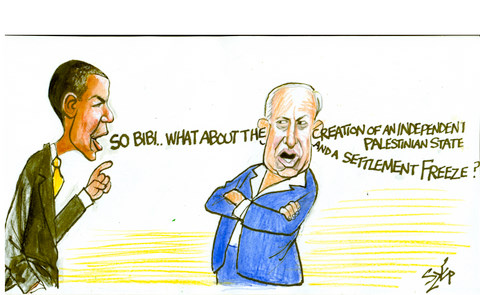
Netanyahu said that contrary to what was reported, "I told Obama that I am prepared to go with this to the cabinet and that I will be able to enforce [the settlement freeze], but then I received the surprising phone call from the Americans who said they no longer demand that Israel extends the freeze." (Source)
Exhibit D) Always looks really weird on TV and in interviews...like he's made of rubber or something.
Is it just me? Check him out on Bill Mahr in 2006, and now look at him on Larry King Live in 2010. Is this really him, or is it a parody of him? Or is it a little boy comedian in a Netanyahu suit? I seriously can't tell.
 |
| Photo Credit: John Springs for The New York Review of Books |
Members of the jury.... I leave it to you to decide!
Friday, December 17, 2010
Middle East Peace Process 2010 Recap: Is the US actually doing anything?
 |
| Cartoons for the Week of Sept. 20-26, 2009 Copyright © 2009 Universal Press Syndicate |
First the US was madly against Israeli West Bank settlement construction and Biden, Clinton and Obama were pushing hard for a settlement freeze. I think we all remember that big to-do with VP Joe Biden when he came to visit. How can we forget how offended he was when he came to promote the freeze last year and Netanyahu stupidly took his visit as an opportunity to tell the whole world that he isn't interested in listening to the US and instead, planned on starting up the settlement building once more.
And so the peace process turned into a debate about West Bank settlement construction. For several months, Hillary and the PA argued with Netanyahu to extend the settlement freeze, which Netanyahu really didn't want to do. No one could get past this issue. It became THE issue. The White House seemed ready to give Israel military equipment in exchange for an extension on the settlement freeze. But it wasn't going anywhere.
And then the US dropped it.
Suddenly the White House had enough and decided that the settlements would no longer be the main issue. They wouldn't be important at all. And this happened right as the House approved a bill that put loads of cash toward an Israeli military security missiles base.
I know, it sounds strange to me too, but whatever. I'm going with it.
So, now we're here. Where is that, exactly? Well, the settlements are underway making Palestinians pretty upset. They are getting fed up with this whole Peace Process thing. The United States is fed up too, but since Obama doesn't have all that much going for him right now, he seems to have taken this on as a new project and he isn't a quitter. But it's gotten so bad that now, the Palestinans, who everyone seems to want to free fro Israeli tyrrany, proclaimed their intention to unilaterally declare a Palestinian state.
"No!" (says the US!) "You can talk to us and to the Israelis and we can pretend we are trying to make peace, but don't do something rash like declaring a STATE!" That would just be madness. Madness,yes, although Brazil and Venezuela are already backing it...and the EU might support it if it ever becomes "appropriate". Not like anyone is supposed to know what that means.
Anyway, I'm not going to take a side right now. I just want to point out how the US looks kinda/really/unbelievably lost here.What have Hillary and Obama gotten themselves into this time?
Saturday, November 20, 2010
Arab/Palestinain Propeganda: Extremists on Both Sides
I typically don't put up posts of this nature.
However, I believe that the Western World is quite familiar with Israeli's anti-Arab sentiments, but frequently forgets the constant barrage of anti-Semitic propaganda that is distributed and promoted in the occupied territories and other Arab countries.
This video, despite its obvious cut-and-paste nature, drives a point home that is important to remember: that in the Middle East, extremism is everywhere.
New Trends in Arabic Anti-semitism from Henrik Clausen on Vimeo.
Friday, September 3, 2010
Israel & Peace: Is Democracy Really the Question Here?
The question is posed time and time again, "Is Israel really a democracy?" Nearly every Middle East political scientist has wondered about Israel's democratic status since the country's establishment.
The answer to this question, of course, depends on your definition of democracy. Princeton's WordNet defines democracy as:
If this is the definition we go with, then Israel is certainly a democracy, albeit a dysfunctional one.
Take a look at the Israeli Ministry of Foreign Affairs webpage that outlines the representative structure of Israel's government. Israel has an elected Parliament, called the Knesset, which is "proportionally representational". Israel's government is elected by the people to represent the people.
There are multitudes of political parties. Here's an official list (in Hebrew) of all of the Israeli political parties. When an Israeli voter goes to cast their vote, they are faced with a list as long as this one with shortened names of every political party. I counted 86, but I may have lost track along the way. Go ahead and take a stab yourself.
Anyway, the way the system works is like this:
The number of Parliamentary seats a party wins in an election are determined by popular vote. Numerical majority rule within the Parliament is required after each election, but because there are so many freakin parties, no one party ever wins a majority of seats. So to create a majority, parties must for coalitions.
Forming a majority coalition requires a series of negotiations between party officials which usually this involve massive concessions made all 'round. Once a majority coalition is created, party officials are initiated and the new government begins its governing. New legislation is then passed by Parliamentary voting.
This is, in a way, a democracy at its most democratic: parties are relatively easy to form, and voters vote directly for their parties. However, the high number of political parties also creates problems. It becomes difficult for those elected to negotiate coalitions, making it a messy democracy. This is exactly what happened in 2009 when the Kadima party won the highest number of popular votes: Tzipi Livni, the head of the Kadima party and the technically "elected" prime minister, was unwilling to make the necessary concessions required to create a majority coalition. She decided it was better to concede her position as Prime Minister than to take the position after forfeiting her party' principles and ideology.
However, it is important to mention that Tzipi Livni's Kadima party, while still centrist, is committed to keeping Gaza and the West Bank under Israeli control. Also, despite the fact that it did win the highest percentage of votes in 2009 at 22.47%, most other voters cast their vote for right-leaning parties, wth Likud, Netanyahu's "central-right" party that has a rather "hawkish" policy towards the Palestinians, coming in second at 21.2% and Yisrael Beiteinu coming in third. You can get the idea of how right Yisrael Beiteinu really leans from their 2009 political slogan, "No loyalty, no citizenship." Most of Israel is right wing and most Israeli leaders are respected Army veterans. This necessarily means less general sympathy towards the Palestinian cause.
The question of Israel's democratic status was addressed by New York Times Op Ed Contributor, Toni Judt on June 9, 2010 in the article "Israel Without Cliches." Jundt writes:
"[Cliche]No. 2: Israel is/is not a democracy
Perhaps the most common defense of Israel outside the country is that it is “the only democracy in the Middle East.” This is largely true: the country has an independent judiciary and free elections, though it also discriminates against non-Jews in ways that distinguish it from most other democracies today. The expression of strong dissent from official policy is increasingly discouraged.
The answer to this question, of course, depends on your definition of democracy. Princeton's WordNet defines democracy as:
Noun
- S: (n) democracy (the political orientation of those who favor government by the people or by their elected representatives)
- S: (n) democracy, republic, commonwealth (a political system in which the supreme power lies in a body of citizens who can elect people to represent them)
- S: (n) majority rule, democracy (the doctrine that the numerical majority of an organized group can make decisions binding on the whole group)
If this is the definition we go with, then Israel is certainly a democracy, albeit a dysfunctional one.
Take a look at the Israeli Ministry of Foreign Affairs webpage that outlines the representative structure of Israel's government. Israel has an elected Parliament, called the Knesset, which is "proportionally representational". Israel's government is elected by the people to represent the people.
There are multitudes of political parties. Here's an official list (in Hebrew) of all of the Israeli political parties. When an Israeli voter goes to cast their vote, they are faced with a list as long as this one with shortened names of every political party. I counted 86, but I may have lost track along the way. Go ahead and take a stab yourself.
Anyway, the way the system works is like this:
The number of Parliamentary seats a party wins in an election are determined by popular vote. Numerical majority rule within the Parliament is required after each election, but because there are so many freakin parties, no one party ever wins a majority of seats. So to create a majority, parties must for coalitions.
Forming a majority coalition requires a series of negotiations between party officials which usually this involve massive concessions made all 'round. Once a majority coalition is created, party officials are initiated and the new government begins its governing. New legislation is then passed by Parliamentary voting.
This is, in a way, a democracy at its most democratic: parties are relatively easy to form, and voters vote directly for their parties. However, the high number of political parties also creates problems. It becomes difficult for those elected to negotiate coalitions, making it a messy democracy. This is exactly what happened in 2009 when the Kadima party won the highest number of popular votes: Tzipi Livni, the head of the Kadima party and the technically "elected" prime minister, was unwilling to make the necessary concessions required to create a majority coalition. She decided it was better to concede her position as Prime Minister than to take the position after forfeiting her party' principles and ideology.
However, it is important to mention that Tzipi Livni's Kadima party, while still centrist, is committed to keeping Gaza and the West Bank under Israeli control. Also, despite the fact that it did win the highest percentage of votes in 2009 at 22.47%, most other voters cast their vote for right-leaning parties, wth Likud, Netanyahu's "central-right" party that has a rather "hawkish" policy towards the Palestinians, coming in second at 21.2% and Yisrael Beiteinu coming in third. You can get the idea of how right Yisrael Beiteinu really leans from their 2009 political slogan, "No loyalty, no citizenship." Most of Israel is right wing and most Israeli leaders are respected Army veterans. This necessarily means less general sympathy towards the Palestinian cause.
The question of Israel's democratic status was addressed by New York Times Op Ed Contributor, Toni Judt on June 9, 2010 in the article "Israel Without Cliches." Jundt writes:
"[Cliche]No. 2: Israel is/is not a democracy
Perhaps the most common defense of Israel outside the country is that it is “the only democracy in the Middle East.” This is largely true: the country has an independent judiciary and free elections, though it also discriminates against non-Jews in ways that distinguish it from most other democracies today. The expression of strong dissent from official policy is increasingly discouraged.
But the point is irrelevant. “Democracy” is no guarantee of good behavior: most countries today are formally democratic — remember Eastern Europe’s “popular democracies.” Israel belies the comfortable American cliché that “democracies don’t make war.” It is a democracy dominated and often governed by former professional soldiers: this alone distinguishes it from other advanced countries. And we should not forget that Gaza is another “democracy” in the Middle East: it was precisely because Hamas won free elections there in 2005 that both the Palestinian Authority and Israel reacted with such vehemence."
It has become increasingly clear that the greatest obstacle to peace in Israel is its own extremist population. The Israeli people are moving farther and farther right. The religious, who are almost entirely far right wing, have far more children and are quickly multiplying in numbers. This is happening at the expense of young leftists who feel more and more isolated and more and more jaded.
As Gadi Taub emphasized in his Aug 29th NYTimes Op-Ed article, "In Israel, Settling for Less", the settlers and settlements are the big, big problem. There is a growing number of Israeli religious extremists who are intent on creating and maintaining a biblical Israel. These are the religious settlers who are not willing to negotiate with Palestinians. They are not willing to consider a two-state solution. And this is not only an obstacle to peace, but as Taub says, if maintained, these settlements will "doom Zionism itself...all 'one-state solutions' lead to the same end: civil war."
I have to agree. This means that international pressure is essential to Israel's survival and essential to the development of any possible peace accord. It is international pressure- not Israeli citizens- that will convince Israeli leaders to stop the settlements and to begin thinking about a real two-state solution. Let's hope that the negotiations which began this week will end with an agreement from Netanyahu to put an end to Israeli settlements in the West Bank.
Subscribe to:
Posts (Atom)