I typically don't put up posts of this nature.
However, I believe that the Western World is quite familiar with Israeli's anti-Arab sentiments, but frequently forgets the constant barrage of anti-Semitic propaganda that is distributed and promoted in the occupied territories and other Arab countries.
This video, despite its obvious cut-and-paste nature, drives a point home that is important to remember: that in the Middle East, extremism is everywhere.
New Trends in Arabic Anti-semitism from Henrik Clausen on Vimeo.

Saturday, November 20, 2010

Monday, November 8, 2010
Otto Bar on Rabin Square: New Tel Aviv Hot Spot!
Surprisingly stylish and well designed, Tel Aviv's Otto Bar (אוטו בר), or Otto 76, is a great place to grab a well-made drink with a lady-friend or pick up a billiards game with the dudes. The owners couldn't have picked a better location. The place is smack-dab across from Rabin Square at 76 Even Gvirol- the center of the white city near some of the hippest, coolest Tel Aviv restaurants and pubs.
Don't be surprised if you pass by the entrance several times on your first trip there. First off, I was certain the place was called "Auto Bar" and when I tried to look up the address, I didn't understand why there was nothing on the internet about this place. Then, once I figured out that "Auto Bar" was really "Otto bar" and I jotted the address down, I still had trouble finding it. The bar is hard to catch, being that there is no real door. The face of the opening corridor looks like a storage unit filled with crates of beers, and unless you know what you're looking for, you might have to do a double take.
The relatively new Otto Bar can be plagued with long lines, since that is the way of hot new Tel Aviv bars, but if you make it there during the week, you should have no problem waltzing right in. Passing the hostess, one enters the dimly lit storage unit and follows the music down a short flight of stairs. The stairs open up to a vestibule lined with light wood-paneled walls and glass windows. Behind the glass more aesthetically stacked beer crates, wine glasses, wine bottles and kegs sit peaking through iron metal fencing.

Walk through two swinging wooden doors to enter and you have a view of the entire bar before you. The bar is low and very central, taking up most of the floor space as typical Tel Aviv pick-up bars do. But this isn't a pick-up bar. Well, not completely.
While the seating is tight and the bar area can get packed, there are some benches and booth-like seating off to the sides near the billiard tables. These are good for groups of friends, or simply side make-out sessions. But, their bar tenders are unbelievably good looking, so I recommend trying to get their early to stake out a seat at the bar.
High-quality beer appreciation culture is also taking hold of this Mediterranean city and Otto Bar caters to the beer lover without question. They have an extensive beer list in addition to their wine, champaign/kava and cocktail lists which I personally appreciate being a sel-proclaimed beer-o-phile. Apparently their prices are a bit steep (their 1/2 liters (Chetzis or חצאים are 400ml) but I don't expect any less from a hip new place like this.
What makes the Otto Bar even more attractive is its fantastic decor. I do have to give them kudos on that. The Otto Bar has classy and warmly lacquered wooden paneling to give it a cozier, classier ambiance, while the walls are a rustic stone giving it a touch of "we're having a party in the basement" kinda feel. The seats are upholstered in dark brown leather (or faux leather) with those buttons that make the seats look like grandpa chairs from the 1940s and all supporting columns are tastefully tiled in black and white. If they had a piano and a lounge singer, it would bring the decor together. But they don't.
The music is good, though it isn't too unique. Lost of interesting 80s music like Squeeze, early Depeche Mode, Brian Ferry and the Police mixed in with some pop music of the 90s and Indie Rock of today. They are nice background tunes that make it easy to mix and mingle, but they don't make you want to get up and bust a move.
Overall, I'd say Otto 76 draws a crowd that ranges from their md 20s to late 30s which keeps the scene tame and charming and dress-code-free. I showed up in a tank top, jeans and sneakers, but I was eying a number of other women in tight mini dresses and stilettos.
Don't be surprised if you pass by the entrance several times on your first trip there. First off, I was certain the place was called "Auto Bar" and when I tried to look up the address, I didn't understand why there was nothing on the internet about this place. Then, once I figured out that "Auto Bar" was really "Otto bar" and I jotted the address down, I still had trouble finding it. The bar is hard to catch, being that there is no real door. The face of the opening corridor looks like a storage unit filled with crates of beers, and unless you know what you're looking for, you might have to do a double take.
 |
| The Entrance to Auto Bar, 76 Even Gvirol |
The relatively new Otto Bar can be plagued with long lines, since that is the way of hot new Tel Aviv bars, but if you make it there during the week, you should have no problem waltzing right in. Passing the hostess, one enters the dimly lit storage unit and follows the music down a short flight of stairs. The stairs open up to a vestibule lined with light wood-paneled walls and glass windows. Behind the glass more aesthetically stacked beer crates, wine glasses, wine bottles and kegs sit peaking through iron metal fencing.

Walk through two swinging wooden doors to enter and you have a view of the entire bar before you. The bar is low and very central, taking up most of the floor space as typical Tel Aviv pick-up bars do. But this isn't a pick-up bar. Well, not completely.
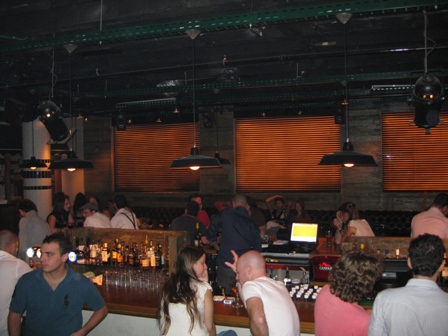 |
| The Bar. |
While the seating is tight and the bar area can get packed, there are some benches and booth-like seating off to the sides near the billiard tables. These are good for groups of friends, or simply side make-out sessions. But, their bar tenders are unbelievably good looking, so I recommend trying to get their early to stake out a seat at the bar.
High-quality beer appreciation culture is also taking hold of this Mediterranean city and Otto Bar caters to the beer lover without question. They have an extensive beer list in addition to their wine, champaign/kava and cocktail lists which I personally appreciate being a sel-proclaimed beer-o-phile. Apparently their prices are a bit steep (their 1/2 liters (Chetzis or חצאים are 400ml) but I don't expect any less from a hip new place like this.
 |
| Pretty wine. Pretty cups. Pretty wood. |
 |
| People, you can't find Sam Adams in most Israeli Bars- bug Otto Bar has got crates of it! |
What makes the Otto Bar even more attractive is its fantastic decor. I do have to give them kudos on that. The Otto Bar has classy and warmly lacquered wooden paneling to give it a cozier, classier ambiance, while the walls are a rustic stone giving it a touch of "we're having a party in the basement" kinda feel. The seats are upholstered in dark brown leather (or faux leather) with those buttons that make the seats look like grandpa chairs from the 1940s and all supporting columns are tastefully tiled in black and white. If they had a piano and a lounge singer, it would bring the decor together. But they don't.

The music is good, though it isn't too unique. Lost of interesting 80s music like Squeeze, early Depeche Mode, Brian Ferry and the Police mixed in with some pop music of the 90s and Indie Rock of today. They are nice background tunes that make it easy to mix and mingle, but they don't make you want to get up and bust a move.
Overall, I'd say Otto 76 draws a crowd that ranges from their md 20s to late 30s which keeps the scene tame and charming and dress-code-free. I showed up in a tank top, jeans and sneakers, but I was eying a number of other women in tight mini dresses and stilettos.
 |
| Billiars. Otherwise known as Snooker. |
 |
| I'm crap at playing, but I must say, I always enjoy it. |
 |
| Tacuma, Hagar and I smilin' it up. |
Wednesday, November 3, 2010
My Love Affair with a Pomegranate
Follow my blog with bloglovin

Not only are pomegranates exquisite in form and precious to countless religions and cultures, but they are also terrificly tasty. Throw some pomegranate seeds in a salad and you've added a sweet crunch thats to die for. Mix up some pomegranate juice with apple and pear juice, and add yogurt if you like for a smooth fruit drink. Place a chicken in the oven and cover it with pomegranate seeds and lemon essence for a sweetly sour delectable dish. The recipes are endless.

If you're looking for a unique Israeli take on the pomegranate, pick up a Rimon Wine - they are a winery that makes their wines entirely from expertly fermented pomegranate juice. Their winery is in the stunning Upper Galilee Region of Israel, which, if you plan to travel in Israel, you should find time for wine and pomegranates aside. I've tasted their wines a number of times and have been pleasantly surprised. They're sweet, but not too sweet: a nice port-substitute and a perfect garnish for a warm pound cake or bowl of vanilla ice cream.

Of course, with such a rich relationship with man, the name, pomegranate, also has an interesting story. "Punica Granadum" is the official genus name, named after the Phoenicias who, with their advanced seafaring, greatly contributed to the spread of it's cultivation. The Latin "pomum" (apple) and "granatus" (seeds) influenced the fruit's name in many Romance Languages. In English, the pomegranate was first recorded as being called "The Apple of Granada", which is thought to be attributed to a mis-transaltion of the French "pome-grenade". The Hebrew, "rimon" (רימון), almost identical in Aabic, "romman, or rumman" (رمان) is also used to refer to a grenade or shell.


It’s the height of pomegranate season in Israel. A walk through any shuk (שוק-market place) and you’ll catch a glimpse of the extraordinary bulbous fruit at nearly every produce stand. It’s deep, earthy smell of soury sweetness is in the air. And so, I dedicate this post to the pomegranate- a fruit that has tantalized the hearts of man for thousands of years.
The pomegranate is an ancient fruit, and holds symbolic meaning which many believe to have been the true forbidden fruit in the garden of Eden. Pomegranates were also one of the first fruits brought back to Moses as proof that the Promised Land was really as good God told Moses it would be:
“For the LORD thy God bringeth thee into a good land, a land of brooks of water, of fountains and depths that spring out of valleys and hills; A land of wheat, and barley, and vines, and fig trees, and pomegranates; a land of oil olive, and honey; A land wherein thou shalt eat bread without scarceness, thou shalt not lack any thing in it; a land whose stones are iron, and out of whose hills thou mayest dig brass” Deuteronomy 8:6-14
The fruit is mentioned frequently in the Bible, typically in connection with beauty, love, romance, and bounty.
Native to the Mediterranean, specifically eastern Iran, the fruit made its way to other areas of the Mediterranean and Asia with the help of Greek and Roman trade. Many Greek myths feature the pomegranates as symbols of fertility, royalty, power or sinfulness, and the exotic crown-shaped fruit has been absorbed into nearly every major culture today including Chinese, Islam, Christianity and Hindu.
The fruit is mentioned frequently in the Bible, typically in connection with beauty, love, romance, and bounty.
 |
| Photo Credit:(clockwise)Painting by IlseKlyn, photo by Graur Codrin, painting by CraigStephens |
Native to the Mediterranean, specifically eastern Iran, the fruit made its way to other areas of the Mediterranean and Asia with the help of Greek and Roman trade. Many Greek myths feature the pomegranates as symbols of fertility, royalty, power or sinfulness, and the exotic crown-shaped fruit has been absorbed into nearly every major culture today including Chinese, Islam, Christianity and Hindu.

If you're looking for a unique Israeli take on the pomegranate, pick up a Rimon Wine - they are a winery that makes their wines entirely from expertly fermented pomegranate juice. Their winery is in the stunning Upper Galilee Region of Israel, which, if you plan to travel in Israel, you should find time for wine and pomegranates aside. I've tasted their wines a number of times and have been pleasantly surprised. They're sweet, but not too sweet: a nice port-substitute and a perfect garnish for a warm pound cake or bowl of vanilla ice cream.


Despite the pomegranates Middle Eastern heritage and mythical reputation, today the fruit is widely known for its incomparable health benefits. As it turns out, the fruit isn't just sweet and crunchy, it's also rich in vitamins A, B, C, iron, calcium, potassium and more. According to recent studies, it neutralizes free radicals in the human body faster than red wine or green tea, meaning it may help prevent cancer, and has also been found to help treat those suffering from high blood pressure!
So, now I revel in the perfection of the pomegranate season in Israel. And, of course, living next to an open air Tel Aviv market where the fruit is fresh and fragrant isn't too bad either!
Sunday, October 31, 2010
Travel in Israel: Mount Tavor (Har Tavor)
If you are looking to travel in Israel, I suggest a day trip to Har Tavor (Mount Tavor). Located in the Lower Galile Region and just overlooking the wide pastoral expanses of Emek Izrael (Jezreel Valley), Har Tavor is a round bushy mountain with a turtle-shell curve and a soft fur of leafy trees.
History
Har Tavor is well known among Jews and Christians alike for being both the site of the Biblical battle between Barak and the army of Jabin (Canaanites) during the reign of Deborah the Prophet as well as the site of Jesus' transfiguration.
Church of the Transfiguration
The top of the mountain, accessible by car, is home to a stunning Church of the Transfiguration erected in the early 20th century. The church boasts some spectacular murals, beautiful mosaics,exquisite architecture and various artifacts from the thousands of years of visitors who came on pilgrimage. The church itself was constructed atop layers of ruins of what was once a Byzantine church, and before a Crusader church.
Har Tavor actually a stop on the "Jesus Trail" for those of you who are interested in "walking in the footsteps of Jesus" on your travels in Israel . (Either way, you should take a look at the site: their header picture of a big comfy yellow couch in the middle of the desert on a Jesus trail does make the hike seem pretty miraculous.)
If you're planning on hitting up the Church of Transfiguration as you travel in Israel, here are their visitors hours: 8:00-12:00, 2:00-6:00. Closed Saturdays. Modest dress required (no shorts or sleeveless).
The Hike
There are a number of nice hikes in the area. Hiking up the actual Mount Tavor is part of the Israel National Trail, Shvil Yisrael (שביל ישראל) which runs the entire length of Israel from top to bottom, (or bottom to top, whichever way you look at it). This means that the trails are well marked and well traveled.
Hikinh the mountain should take about 4 hours up and down, or you can choose to simply hike around the mountain in Beit Keshet Forrest.
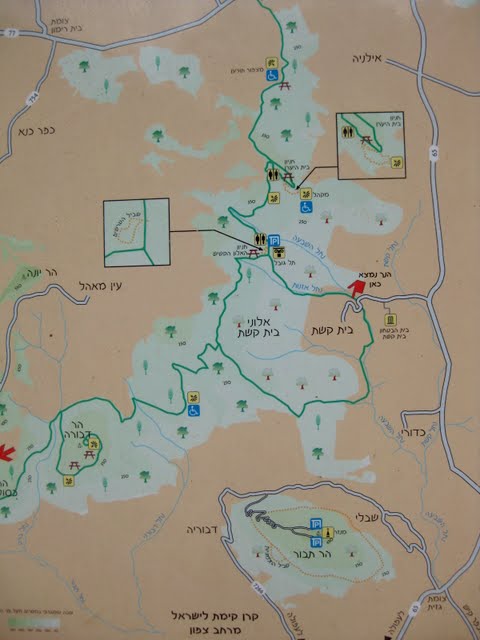
Here's a map of the area:


It's the perfect place for a cheesy photo.
We then continued our wandering down and around the forest, slowly making our way back to our parked car. Our somewhat disorganized wandering hike took us approximately 5 hours including two snack breaks and several moments when I was certain we'd completely lost the way.

All in all it's a great day trip for anyone who happens to be traveling in Israel.
For more information, visit the following sites:
http://www.bibleplaces.com/mounttabor.htm
http://meafar.blogspot.com/2010/10/mount-tabor-har-tavor.html
http://onajunket.com/israel/the-plain-of-jezreel-mount-tabor-israel.html
History
Har Tavor is well known among Jews and Christians alike for being both the site of the Biblical battle between Barak and the army of Jabin (Canaanites) during the reign of Deborah the Prophet as well as the site of Jesus' transfiguration.
Church of the Transfiguration
The top of the mountain, accessible by car, is home to a stunning Church of the Transfiguration erected in the early 20th century. The church boasts some spectacular murals, beautiful mosaics,exquisite architecture and various artifacts from the thousands of years of visitors who came on pilgrimage. The church itself was constructed atop layers of ruins of what was once a Byzantine church, and before a Crusader church.
Har Tavor actually a stop on the "Jesus Trail" for those of you who are interested in "walking in the footsteps of Jesus" on your travels in Israel . (Either way, you should take a look at the site: their header picture of a big comfy yellow couch in the middle of the desert on a Jesus trail does make the hike seem pretty miraculous.)
If you're planning on hitting up the Church of Transfiguration as you travel in Israel, here are their visitors hours: 8:00-12:00, 2:00-6:00. Closed Saturdays. Modest dress required (no shorts or sleeveless).
The Hike
There are a number of nice hikes in the area. Hiking up the actual Mount Tavor is part of the Israel National Trail, Shvil Yisrael (שביל ישראל) which runs the entire length of Israel from top to bottom, (or bottom to top, whichever way you look at it). This means that the trails are well marked and well traveled.
Hikinh the mountain should take about 4 hours up and down, or you can choose to simply hike around the mountain in Beit Keshet Forrest.
Here's a map of the area:

For those readers who are not Hebrew Literate, the large white blob in the center of the map is the Beit Keshet forest. Mount Tavor is the small white splotch just by the bottom of the map. We started where the big red hand is pointing. We parked a bit further, by the blue "Park" symbol where there are restrooms and a parking area and walked towards south. Then we continued on towards that red arrow on the far right, before wandering back through the forest straight towards the car.
 |
| Entrance map |

We really pottered through the forest, trying to find the best views of Har Tavor, and following the bike path, despite the fact that we were traveling on foot. The bike path is highlighted below in yellow.


We eventually made it to a beautiful view point overlooking Har Tavor where we inhaled an entire package of cookies with dark black coffee. It's a great look out point to stop at if you want a bit to eat, but I just don't recommend consuming an entire package of whatever it is you brought. Trust me. It makes the next leg of hiking., well, uncomfortable. So stick to the coffee and a sandwich or one/two cookies and you're good to continue on your way.


It's the perfect place for a cheesy photo.
We then continued our wandering down and around the forest, slowly making our way back to our parked car. Our somewhat disorganized wandering hike took us approximately 5 hours including two snack breaks and several moments when I was certain we'd completely lost the way.

All in all it's a great day trip for anyone who happens to be traveling in Israel.
For more information, visit the following sites:
http://www.bibleplaces.com/mounttabor.htm
http://meafar.blogspot.com/2010/10/mount-tabor-har-tavor.html
http://onajunket.com/israel/the-plain-of-jezreel-mount-tabor-israel.html
Saturday, October 30, 2010
Religious vs. Secular: Segregated Housing Endorsed by Minister
 |
| Housing and Construction Minister, Ariel Atias |
According to a recent article by Ynet news, Housing and Construction Minister, Ariel Atias, is fervently endorsing haredi-designated cities.
The segregated housing issue was discussed by Israeli officials and haradi and secular community representatives at a conference organized by the Gesher Foundation, an organization ironically founded to promote dialogue between the religious and the secular.
In Hebrew, Gesher (גשר) means bridge, although from reports on their most recent housing conference, it sounds like they are having a tough time trying to meet their goals of " strengthening the fabric of Israeli society through the appreciation of our shared Jewish heritage and common destiny."
In Hebrew, Gesher (גשר) means bridge, although from reports on their most recent housing conference, it sounds like they are having a tough time trying to meet their goals of " strengthening the fabric of Israeli society through the appreciation of our shared Jewish heritage and common destiny."
The conference, held on Tuesday, October 26th, was held in Jerusalem and titled "Segregated Country".
Most of the religious in attendance, including Minister Atias himself, made it very clear that they are happy to remain isolated and would prefer living in an area where they would not have to have any interaction with secular Jews.
"I am in favor of separate housing in separate neighborhoods for haredim," said Atias. "I would not let my children meet with secular youth."
Atias continued by implying that even without a city-backed plan, the haredim would eventually grow to become the majority in many communities and would seize control organically. "Haredim will take over secular neighborhoods if ultra-Orthodox cities or neighborhoods are not planned," Atias said.
I was particularly confused by remarks made the director of the Gesher foundation regarding the conference. According to Ynet's report, Gal-Dor said he welcomes the Minister Atias' willingness to "take responsibility for building apartments for haredim" and added, "We must find bridges to break the divides and streotypes that exist among the populations."
When did segregation become a "bridge that breaks divides"? I mean, did I miss something here?
Also in attendance was former Housing Minister Yosef Paritzky and Deputy Jerusalem Mayor Yitzhak Pindrus, who exchanged some harsh words regarding housing segregation:
"I don't care about haredim. We're all minorities and the country has to instate equality both in duties and privileges," Paritzky said. Pindrus, a haredi, responded to Paritzky's remark by saying: "Don't try and educate us. We're 700,000 people who want to live separately according to our own lifestyle."
Apparently Atias already has a haradi city plan in the works. He's been promoting planning for an ultra-orthodox city in the community of Harish in Wadi Ara since the spring despite opposition from local Jews and Arabs. He has also been criticized in the past for advancing the establishment of a haradi city in Beit Shemesh, near Jerusalem, which lead to massive legal battles between himself and the city council.
Atias has also been criticized for arguing that Jewish and Arab populations, like secular and religious ones, should also be kept separate from one another.
I always thought that the best way to promote dialogue and build bridges was through interaction and coexistence, but it seems that the religious communities see things quite differently.
I always thought that the best way to promote dialogue and build bridges was through interaction and coexistence, but it seems that the religious communities see things quite differently.
Recipe: The Perfect Pita
Another one of my friends, Roni, turned 30 last weekend (yep- another one) and to celebrate, a group of us friends and most of his family family somehow managed to lure him to a surprise camping adventure in Beit Hananya near Ceasarea. It was a near perfect surprise....and it's always fun to jump out at someone from behind the bushes.


Roni was thrilled, and we all enjoyed ourselves. There was music, food and festivities. |What made the entire event especially enjoyable was the high quality of the camp site. The camp grounds in Beit Hananya are the nicest I've seen in Israel: There was a shack with refrigerators open to public use, lights, electricity outlets, sinks, bathrooms and even showers.
Aside from the fantastic facilities, Beit Hananya also offers activities to parties camping at their site. Our party of maybe 40 or more happily partook in pita making!
Here's a snapshot at how we made some plain dough into delicious pitot.
Ingredients:
3 Cups of All Purpose Flour (we used white flour but you can mix it up with wheat flour too.)
2 Teaspoons instant yeast
2 Teaspoons Kosher Salt (regular salt is fine,
1 Teaspoon sugar (or honey)
3 Tablespoon Extra Virgin Olive Oil
1 1/4-1/12 cups of warm water (not too warm, room temperature is good)
Preparation:
Place all the dry ingredients into a bowl, mix, and then add the olive oil and 1 1/4 cups of water. Stir mixture well till it turns into a big lump of dough, or in Hebrew, a "gush batzek" (גוש בצק). Then knead knead and knead. You'll have to do this for about 5-10 minutes. Knead till the dough is sticky, but not dry, and all the flour sticks to the lump. If it doesn't add more water and knead a bit more.
Once the lump of dough looks good, place it in a greased bowl, cover the bowl, and let the dough sit for about 2 hours. The dough should double in size. It should also be a bit stickier than before.
Now coat your hands with flour, dust the dough ball with flour and dust your working surface with flour. You're now ready to start making pita doughballs!
 |
| Roni works the dough into dough balls |
 |
| Notice the iphone. It has nothing to do with making pitas. |
 |
| Roni gets moral support from friends and family. Apparently dough-ball making can make you feel like less of a man. I had no idea. |
 |
| Dough-ball making is so easy, even little people can do it. |
Now, once you have your dough into a nicely sized ball, you must flatten it. You can do this in a variety of ways.
 |
| 1. With a stick that acts as a rolling pin |
 |
| (don't forget to dust the ball, stick and surface with flour) |

 |
| 2. Pat it flat in your hands |
|
| Nice and patted |
 |
| 3. Or you can roll it with a stick on your hand. As you can see from the picture above, Roni prefers this method, although it's by far the least practical. |
Now, the traditional way of making flat pitas Bedouin-style is to cook them quickly on a large heated pan. If you're making pitas at home, you can either bake your pitas in the oven, or you can fry them on a skillet.
Baked Pitas:
Preheat the oven to 400 degrees (let the flattened dough sit for about 15 minutes while you do this) and then place your flattened dough-balls on a cookie sheet or pizza stone. Bake for 5 minutes max for soft, fluffy pitas. Remove and let cool. Then eat! yum!
Fried Pitas:
Coat your skillet (frying pan, whatever) with a very light coating of olive oil. These come out chewy, and I think they taste the best when the dough is especially flat. Place the flattened dough-balls in the skillet for 1-2 minutes on either side so that each side is seared by the pan. Then remove and eat!
Bedouin Style:
Build a fire beneath a large metal pan. Once the entire pan is heated, coat it in a bit of olive oil and start cooking. Place the flattened pita dough-balls on the large pan and sear either side of the bread. If the pan is sufficiently hot, and the dough sufficiently flat, the pita should cook for less than 1 minute per side. Our pitas took a bit longer since out flattening methods were not the most efficient.


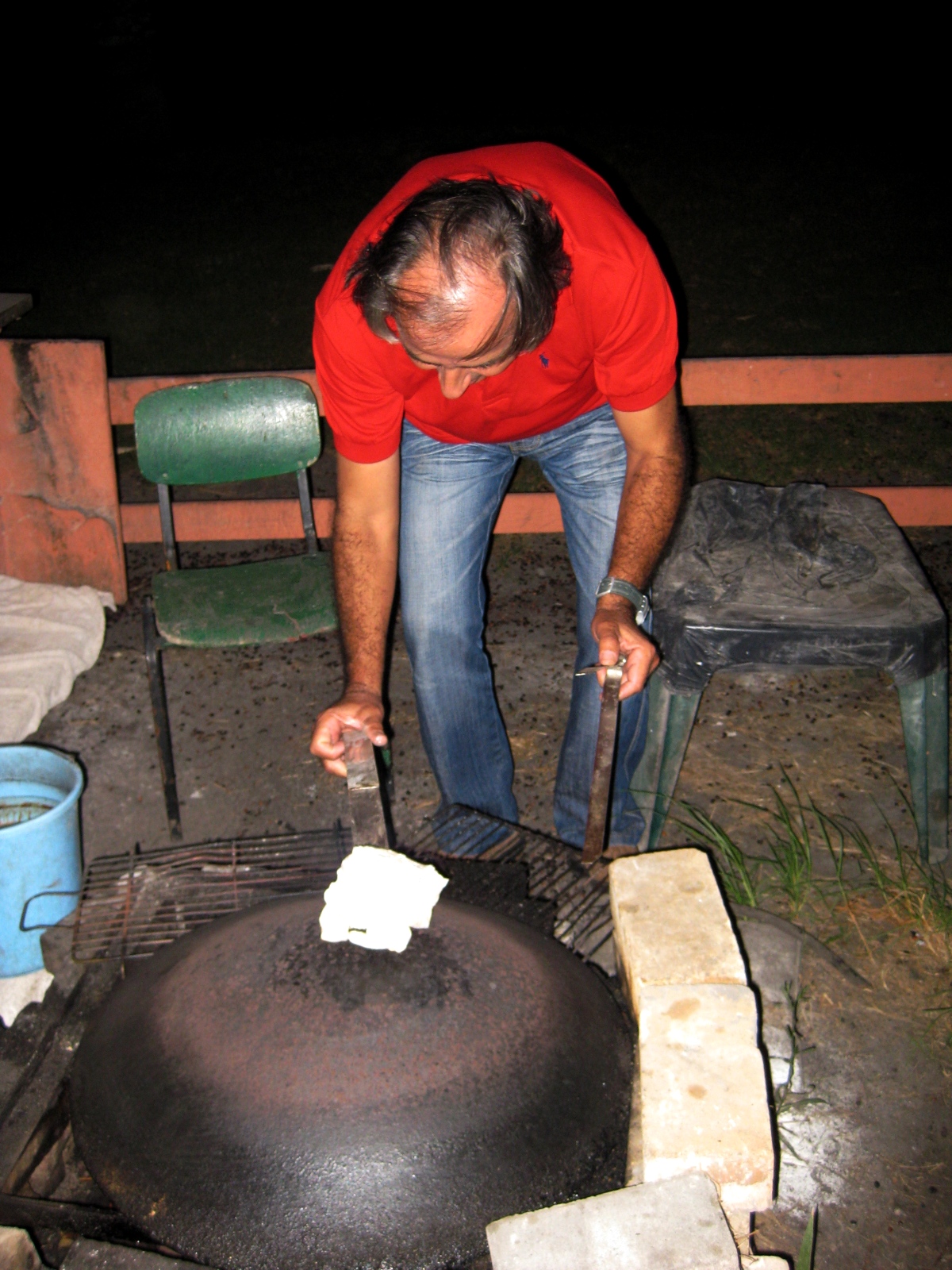


A nice garnish is Zaatar in Olive Oil, T'china, Hummus or Labane cheese (soft soury cheese). If you can get your hands on Zaatar, a staple Middle Eastern spice, I definitely recommend it with a fresh pita.
Here I am below, enjoying a fresh pita with a garnish of Zaatar in Olive Oil.
 |
| Zaatar in Olive Oil |
 |
| Tasty bread! |
Sunday, October 17, 2010
Chilean Delegation at Western Wall Gives Thanks for Miners' Rescue
 |
| Courtesy of IsraelNationalNews.com |
After 33 Chilean miners were miraculously rescued last week, having been trapped underground for over two months, on Sunday, October 17th, five delegates from the Chilean Parliament flew to Israel to give thanks at the Western Wall for the phenomenal rescue.
The five Chilean parliamentary delegates were accompanied by a number of prominent figures in the Chilean Jewish community.
As reported by IsraelNationalNews.com, the official rabbi of the Western Wall, Rabbi Shmuel Rabinovich, greeted the entire group offering his congratulations and emphasizing the magnitude of the rescue that took place. Rabbi Rabinovich remarked how the Jewish people stood watching along with the rest of the world during the rescue mission and rejoiced as each and every one of the miners surfaced alive and well. He then, appropriately, led the group in prayer.
The delegation arrived in Israel only days after Leonardo Farkas, a Jewish Chilean mining executive and well known philanthropist, generously gifted each one of the 33 miners $10,000.According to the Associated Press report, Farkas gave the checks, each written out to the individual miner, to their families and also set up a fund to collect additional donations. Ten thousand dollars is more than some of the miners make in an entire year.


Subscribe to:
Posts (Atom)