During difficult times and after miraculous events, people tend to strengthen their faith in God. And what better place to engage with the G-to-the-O-to-the-D, but Jerusalem, the holy city? Marriage troubles brought Ashton Kutcher and Demi Moore to Israel , but a miracle brought the Chileans.
After 33 Chilean miners were miraculously rescued last week, having been trapped underground for over two months, on Sunday, October 17th, five delegates from the Chilean Parliament flew to Israel to give thanks at the Western Wall for the phenomenal rescue.
The five Chilean parliamentary delegates were accompanied by a number of prominent figures in the Chilean Jewish community.
As reported by IsraelNationalNews.com, the official rabbi of the Western Wall, Rabbi Shmuel Rabinovich, greeted the entire group offering his congratulations and emphasizing the magnitude of the rescue that took place. Rabbi Rabinovich remarked how the Jewish people stood watching along with the rest of the world during the rescue mission and rejoiced as each and every one of the miners surfaced alive and well. He then, appropriately, led the group in prayer.
The delegation arrived in Israel only days after Leonardo Farkas, a Jewish Chilean mining executive and well known philanthropist, generously gifted each one of the 33 miners $10,000.According to the Associated Press report, Farkas gave the checks, each written out to the individual miner, to their families and also set up a fund to collect additional donations. Ten thousand dollars is more than some of the miners make in an entire year.
If you're ever near Haifa and you're itching for a nice hike, here's a good 6 hour hike that promises shade, challenge, gorgeous views, and in the winter, spring, or autumn...water!
I've taken the liberty of doing a quick translation of detailed information about the hike from www.tiuli.com, a great website for hikers with information about various hikes and trails all over the country.
The trail sits right in the heart of the Carmel, and the Kelach (כלח) and Galim(גלים) springs in "Little Switzerland"(שווצריה הקטנה) are considered to be some of the most beautiful in the area. The region is green year round with fantastic views of the Mediterranean, limestone caves, and a peaceful serenity in the air.
It's important to remember to bring a flashlight and a bathing suit for bathing in the cool tunneled waters of Kedem Spring (עין קדם).
The hike that Yotam and I chose to do takes about 6 hours (if you decide to take a dip) and isn't circular. It's recommended you have someone drop you off at the beginning and pick you up at the end- although you're almost sure to find someone willing to give you a ride to the center of town, and its only a 5 minute walk from the end of the trail to the nearest service taxi route. The entire hike is down-hill, but be aware that some down-hill sections are quite challenging and isn't generally recommended for families.
The trail begins just before Haifa University near Dimon Intersection off of Rte 721. Just before you reach Dimon Intersection you'll notice a number of gravel lots off to the side of the road where you can pull off to park. Look for a blue trail marking to begin your decent down Kelach stream (the stream is dry). We had difficulty finding the blue markings and had to ask other hikers we ran into to point us in the right direction. But eventually we found it.
After you find the trail, you'll make a quick decent into a deep forresty area filled with gnarly oak trees (אלון), the red eastern strawberry trees (קטלב), and Judas trees, also known as Red bud trees or love trees (כליל אלון) which are folled with beautiful pink flowers in the springtime.
About 1.5 kilometers into the hike, the blue trail intersects with a red trail that also arrives at the caves, but we remained on the blue trail and continued down hill for about another kilometer till we reached an intersection with a green trail. This green trail is the beginning of Nachal Galim. We noted the green, marking the beginning of Nachal Galim and remained on the blue trail, continuing another 2.5 kilometers through the foliage and over the dried river stones.
Our next stopping point was Nahal Nadar (נחל נדר) with a black trail marking. We turned right following Nahal Nadar which introduced us to a bit of sun and a bit of upward climbing till we reached Ein Kedem. Sadly we hiked the trail at the very end of the summer (Oct 1st) and the water outside of the cave was already dried up. Typically the waters are cool and clean, streaming from narrow tunnels that you can walk through if you have a flashlight. When we arrived, there was still a bit of water deeper inside the cave, but we hadn't brought a flashlight, so we decided to continue onwards.
We followed the blue trail a few more meters till we saw the mountain with the limestone caves to our left call the Oranit Caves. At this point one can either continue on the blue trail below and follow Nahal Galim all the way down, or one can turn left and climb up the mountain into the caves. It's a steep climb, but its doo-able for anyone - and I highly recommend it. The caves are unbelievable and offer by far the best views on the hike.When you get up there, take your time wandering around, and don't miss the blatant photo=op. With the green mountains and the sea in the background, no one can look that bad.
(Note: According to tiyuli.com, the Oranit Caves site is an important winter home to a large number of bats and entrance into the cave is technically forbidden between the months of May and October when they hibernate. However, we saw no signs and no rangers, and until I read this post thoroughly, I had no idea. )
When you're ready, continue through the narrow passages of the caves along the red trail. Climb down from the caves, and follow the red markings. Make sure you descend in the direction of the sea (veer "right" down the mountain and then straight toward the Pais Center which is easily visible). We had a bit of difficulty following the red marks immediately after we climbed down from the caves, but we wandered along in the right direction and ran into it quickly.
This last leg of the trail is very easy and very short.
Here's a snapshot of some of the highlights of the hike. I hope you enjoy!
The big 30. This was the year that I started feeling it. No, I'm not quite there yet, but many of my chaverim (חברים, friends) have reached that nice ripe age of no longer young, but not quite old. You'd think that after about ten 30th birthdays this year we'd start running out of ideas of presents for friends. But, we somehow managed to squeeze out another creation.
In honor of my friend Noa's 30th year of life and in light of the fact that she, her husband Nir and their little girl Tom will be moving this winter to Hong Kong for two years, our branja (ברנג'ה, group of friends) got together to do something really special. We decided that she needed to take with her something that would remind her of us day in and day out, and ensure she never forget how awesome she was to us. Irony becomes us so we took the old clichéd "Last Supper" painting and made it our own. Of course, Noa had to be Jesus. That went without saying.
So, I know that today's post is a bit of a digression from my typical Tel Aviv ramblings and Israeli political posts, but I thought you might enjoy this evolution of a 30th birthday present by my Israeli Havurah.
The paintings on the wall are gone!
Photoshop is Unearthly
Nearly Complete.
Final verion. Printed on canvass and then painted on top with acrylic. Noa looks at her gift and says "This is good. "
While I've been pretty diligent in my Aliyah experience about soaking up as much Israeli culture as possible, my Israeli music education has been a bit lacking. Maybe it's because the Israelis I've befriended are into indie American music and international rock music and maybe it's because of my own laziness. Whatever the case may be, there is a whole world of Israeli music out there that I'm slowly but surely learning about. Here's a snapshot of my first real encounter with the musical genre known as "Mizrachi".
This week I attended the wedding of one of my many Israeli cousins just overlooking the sea on Herzliya beach, a wealthy suburb north of Tel Aviv. The wedding was a very typical Israeli wedding with drinks, a short ceremony, and buffet style food in an outdoor venue. When the dance music started up, I realized how truly Israeli the wedding really was.
Sure, I'd nibbled my fare share of falafel balls and techina and had downed a good three or four champagne cocktails before I noticed the dance floor filling up with lights, party smoke and people, but I was aware enough to feel an excitement in the air.
Now, before I continue, let me describe the venue first so you can get an idea of the event in its entirety. The venue itself was an outdoor venue- a large wooden deck overlooking the sea- the dance floor was actually a space off to the side with a separate bar, a stage, and a hallway to the kitchen and bathrooms-- that was enclosed entirely in glass. So, when the lights turned on, the smoke began filling the floor and the band started setting up, the entire production could be seen through the glass from our tables on the deck as we noshed on sushi and asked the waiters to fill our wine cups. It was like watching some anthropological experiment. Fascinating.
As soon as waiters came to clear our dinner plates, the music started up and the tables of young guests- late twenties to early thirties- rushed into the glass-enclosed dance floor. There seemed to be quite a stir, and a murmur ran through the crowd of guests when the singer took to the stage and started singing. It didn't take long before someone turned to me and said, "Can you believe it? They got Moshe Peretz to play at their wedding!"
Without realizing the height of my ignorance, I blurted out "Who's Moshe Peretz?"
My question was met by expressions of both shock and sympathy- shocked that i live under a rock and sympathetic to the fact that I a) I don't realize the expense the family must have gone through to have him sing at the wedding and b)haven't been fortunate enough to familiarize myself with such a star. Turns out that Moshe Peretz is an extremely famous Israeli singer. Extremely. Google him in English and you'll find picture upon picture, disc upon disc, article upon article by him and about him. Google him in Hebrew and you'll find even more. Moshe Peretz is an Israeli celebrity, a member of the rich an famous: a true pop-rock star who is known for his Mizrachi voice and dark Middle Eastern good looks. So how is it that I've never heard of him?
To really answer this question, let me take you back a few decades to Israel's earliest national cultural movement.
Israeli Cultural History 101 (in a few paragraphs or less): Most of the early Israeli immigrants were European and Eastern European. This lead to the establishment of Westernized national institutions. Israeli education was Western, with an emphasis on subjects that had been revered in countries like Russia and Germany. Israeli dance resembled a mix of European and Eastern European folk dance and the music was quite similar. You know- violins, accordions, clarinets, etc. This was the music that played on the radio and the Western aesthetic was perpetuated in all cultural areas of life.
Fun fact: you may be surprised to hear that the guttural "r" of today's modern Hebrew was actually thought to be ugly and improper in the days of Israel's infancy. If you pick up a popular music CD from the 50s,60s or even 70s, you'll notice that the singers prononce their "r"s with a flipped tongue, like a Russian "r". Only in the mid to late 70s did it slowly become acceptable for singers radio news casters and other official public speakers to pronounce the popular gluttoral "r". In short, Eastern pronounciation = no-no and Eastern European pronounciation = yes-yes.
But, lets get back to Israeli history. Despite the fact that most early immigrants were European, by the 1950s, thousands of immigrants poured in from Greece, Turkey, Yemen, Morocco, Iran, Iraq, and other Eastern and Middle Eastern countries. They began performing their genre of folk music in Hebrew- they began singing Hebrew lyrics to Eastern tunes played with Eastern instruments, and sung in an "Arabian" way with trills and guttoral consonants, creating a new form of Israeli folk music called Mizrachi music, which literally translates to "Eastern music".
Shoshana Gabay, co-creator of a documentary on Mizrachi music called "Yam Shel D'Maot" (Sea of Tears) was interviewed about the genre by Jewish Federation of North America in June 2010. In their article, "Once Considered an Oriental Sound, Mizrachi Music Now Pervades Mainstream", Gabay explained the Mizrachi music phenomenon as a new interpretive mix of music:
"They had all these parties, and at those parties they took what they had learned in school -- Russian-inspired Israeli songs, some Chasidic songs -- and made them Oriental sounding. They blended these songs with popular Arabic songs and traditional Yemenite songs and made a mix out of them. They were making an interpretation, their own interpretation."
But, just as the gluttural "r" was initially met with antagonism, so was Mizrachi music. It wasn't played on the radio, nor was it taught in music school. Only in the 1970s when the cassette tape emerged did some Mizrachi songs make it into the radio with "Perach B'Gani" (פרח בגני, Flower in My Garden) dubbed as the first major Mizrachi hit.
Hits like these became more and more popular among the younger generations of Israelis who began buying Mizrachi cassettes, but it took nearly another decade before Mizrachi music hit the mainstream radio stations, night clubs and bars. Today, Mizrachi music is extremely popular in Israel. Extremely. I head it in the streets, and I imagine it's especially popular in my neighborhood- Hatikvah- an area that is filled with Moroccan and Yemenite families.
So, how don't I know who Moshe Peretz is?
Well, as I said before, I haven't been diligent enough with my Israeli music education. I don't really listen to popular radio. I don't have a car so I don't listen to radio on long drives, and at home our music is saved on our computer. Second, I don't go to pick up bars. I'm just not a fan of tightly pack spaces infused with the smell of ten different colognes and perfumes and then topped off by air conditioned cigarette smoke. Plus, I have a boyfriend :).
Finally, as much as I appreciate the Eastern singing and Eastern musical beats and instruments, most of the popular Mizrachi music is syrupy pop-music, which I have a very small palate for. The most popular songs are pretty cheesy, with similar themes as those found in American country music or R&B- the man is sad about his woman leaving, or the woman is mad at her man for leaving, or the two are just so in love with one another that they have to sing about it. I don't hate it, but I don't love it either.
Now, Mizrachi fans have fought long and hard to be accepted by music critics, and are still fighting the fight. All I can say is, Mizrachi music is a hugely popular genre that is already big with the young'ns. They way i see it, it will be accepted sooner or later by the critics and academics. But it's still a touchy subject. In fact, I happened to find a 2009 ynet article about the crappiest Mizrachi songs and I thought it was pretty funny, but many took it hard.
Whatever the case may be, I now feel lucky to have had the opportunity to see Moshe Peretz, if not up close, then through nearby glass walls that enclosed the smoke-filled dance floor at my cousin's wedding, and to see how many Israelis my age have opened their arms to Arabic-style, Eastern culture and music.
Moshe Peretz on Stage with the bride and groom
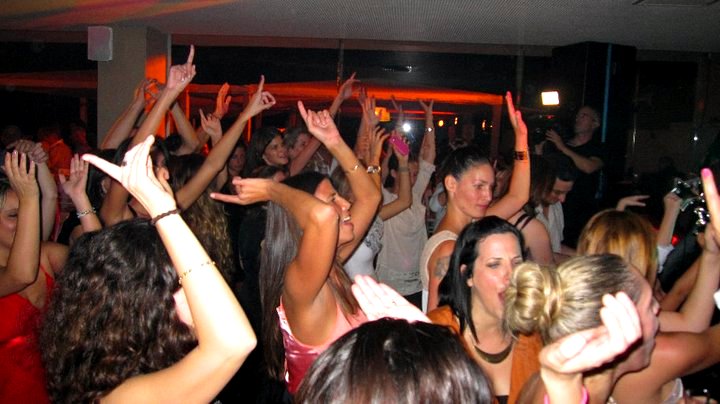
Dancing To Mizrachi music usually involves waving your hands in the air either in a motion that seems to signal that the rest of the crowd get up out of their seats to dance with you.
Hands in the air- all the pretty ladies that like Mizrachi Music :)
I figure that the Israeli Holiday Season is a great time to clear my conscience and use my blog to improve my standing in the eyes of the big guy in the sky. I know I still got time since everyone here in Israel is still using the salutation "Hag Sameach" (חג שמח) meaning "Happy Holiday", and the valediction "G'mar Chatimah Tova" (גמר חתימה טובה) literally meaning "good final inscribing", but idiomatically meaning "May you be inscribed in the book of life forever". These sayings are directly related to the first three holidays of the holdiay season: Rosh Hashannah, Yom Kippur and Sukkot.
"The days of repentance are divided into two parts: The first the inscribing begins on Rosh Hashana and finishes Yom Kippur when the final "sealing" (chatima) of our fate takes place. Many sages give us a second chance - an extra 12 days until a really final sealing on Hoshana Rabba (the 7th day of Sukkot)."
All right! I guess I can wipe the sweat of my brow since there are still a few more days left of Sukkot. I can still use these extra 12 days to do as much good as possible and earn me some "mensch points". So here goes. Let's cross our fingers that I make it into the "good book".
Considering that for the past three years I've lived in areas of Tel Aviv which are highly concentrated with African immigrants, its surprising that I haven't heard of "Advocates for Asylum" (AOA)until recently.
Advocates of Asylum, or in Hebrew, פעילים למען פליטים (P'ilim L'ma'an P'litim), is an organization that is dedicated to promoting a just Refugee Status Determination (RSD) process in Israel.
According to AOA, the current Israeli policies toward asylum seekers are not simply inadequate, they are also grossly unfair and surprisingly out of line with Jewish Halacha (Jewish Law) and the 1951 Geneva Convention for the Protection of Refugees. The '51 convention was actually initiated by Ben Gurion and other world leaders to prevent the deportation of Holocaust refugees in the wake of World War II.
AOA reports that "...today, hundreds (perhaps thousands) of asylum seekers have been forcibly deported by Israel back to Egypt, where many refugees are killed, raped, abused, and/or deported to their country of origin, including Darfur and the Democratic Republic of Congo (DRC)."
These individuals endure extreme hardship in their journey from their homeland to Israel. Egyptian soldiers do not hesitate to open fire at any asylum seeker attempting to cross the border from Egypt to Israel, employing an official "shoot to stop" policy . When they reach Israel, many are immediately deported back to Egypt or Sudan where they typically disappear.
In April, NY based "Human Rights Watch" quoted Joe Stark in their article on the issue: "By definition, a refugee is someone who has a well-founded fear of persecution," said Joe Stork, deputy Middle East and North Africa director at Human Rights Watch. "To send that person back to a place where his life or freedom would be threatened is illegal and inhumane."
To be more specific, "Asylum seekers" are defined as any individual appealing to be recognized as a "refugee". Article I of the 1951 UN Convention Relating to the Status of Refugees defines a "Refugee" as:
"A person who owning to a well-founded fear of being persecuted for reasons of race, religion, nationality, membership of a particular social group or political opinion, is outside the country of their nationality, and is unable to or, owing to such fear, is unwilling to avail him/herself of the protection of that country."
Despite the declaration of the Geneva Convention, asylum seekers that attempt and succeed in crossing the Egyptian border into Israel are not recognized as asylum seekers, but are refereed to as "migrant workers" or infiltrators". This makes it nearly impossible for them to even apply for political asylum from the very get-go.
The Israeli Defence Force (IDF) refers to the Infiltration Prevention Bill of 1954 when dealing with asylum seekers who cross the border from Egypt to Israel. This bill allows deportations, ignoring the Geneva Convention for the Protection of Refugees from 1951. According to Stephen Lendman, blogger, journalist and political activist, “Israel’s 1954 Prevention of Infiltration Law was enacted to criminalize fedayeen freedom fighters, deny Palestinians their right of return, and deport them if they came.”
(Side note: Lendman's May article in the "Palestinian Chronicle" is actually pretty interesting, and very thorough. For anyone that has the time to take a look at his take on the refugee issue in Israel, I recommend a quick read. )
What's more, the government has expressed their intention to amend the current Infiltration Prevention Bill from 1954 to legalize the immediate deportations of asylum seekers.
In their effort to raise awareness about the plight of asylum seekers in Israel and promote a fair RSD system in Israel, Advocates for Asylum has begun compiling and circulating refugee testimonials to policy makers, the public and the media.
Below you'll find an animated testimonial of "Gabriel", a Sudanese asylum seeker living in Israel created by AOA.
In the spirit of the Jewish Holiday Season, go check out AOA's website. There are a number of ways you can volunteer or help contribute to the cause.
Yom Kippur in Israel is almost magical. Nearly everything stops. Everything is quiet. No cars, trucks or scooters pollute the roads; no construction noises pollute the air and no radios blare with music. Everything is still. That is, except for the bicycles. If you an Israeli kid under the age of 18 and you don't have a bicycle to ride on Yom Kippur, your parents are abusing you. This is a day where the streets are filled with people, dressed in white as a symbol of purity, coming and going from the synagogue; children speeding through the roads with skateboards, bicycles and roller skates; and mothers sitting in plastic lawn chairs int he middle of the street.
My boyfriend, Yotam, my friend Eyal and I took this opportunity to visit our friend who lives in Rishon L'Tsion, a suburb which is about 20 minutes drive south of Tel Aviv. It took us about 40 minutes by bicycle as we stopped in towns like Bat Yam along the way.
Here's a short video I put together of Yom Kippur Evening and Yom Kippur Day so that you all can get an idea of what it's like.
*NOTE*: blog address at the end of the video is INCORRECT!
Correction: http://therayve.blogspot.com
I know it's been a while since my last blog post. You'll have to forgive me. I spent my New Years vacation with my friend Annie in the beautiful country of Jordan visiting one of the worlds wonders: Petra.
I whole heartedly recommend a Petra visit to everyone willing to take the time and wander around for at least two days. The site is massive - once the capital city of an entire people, the Nabateans - and it is filled with beautiful rock carvings in so many places, most tourists don't even know where to look. I've learned that the best way to see a site is to trust the locals who live there, and this is exactly what Annie and I did.
Surprisingly, Petra is not only a massive ruin with unbelievably well preserved remnants of exquisite buildings carved out of colorful rock. It's even more than that. Petra is a site surrounded by two major towns/villages: one Arab village and one Bedoin village. These locals wander in and out of Petra at their leisure as they know the back roads and are familiar with the dirt paths that wind up and around the many ancient caves and beautiful arid mountains. We befriended a number of these smiling faces within the city walls who were simply looking for a way to spend their time with excited travelers, and possibly make a tip or two on the side. Us being poor, we kept the few dinars we had in our wallets, but were careful to offer plenty of thanks. And of course, we were willing to follow them wherever they took us.
Our first guide, whose name I can't recall, was a young Arab outfitted in a green army uniform. How did we meet him? Well, he offered to take our photograph. Then he simply continued to set up shots in different areas nearby until we found ourselves following him as he hopped from rock to rock, stone to stone and cliff to cliff. If we'd had more time, which I wish we had, I would have followed him up, up, up to the "high point" he was telling us about from where we'd have an unobstructed view of the Treasury from above. The pictures he took really came out great.
Here he is waving to us as we approach
Here he is showing us how to make blush out of red rock powder
Close up of my - now beautiful- complexion
He was gracious enough to help us along, pointing out in broken English the sites of note and the crevices here and there that made for great photo ops. Here are some of his exclusive shots:
I don't know how we decided on this pose, but it looks freakin cool
The Charlie's Angels thing was his idea. Really.
Me in a hole. You can't say he doesn't have a natural eye.
There will be plenty more photos to come, but I think I'll continue the adventure in the next post. So... Stay tuned!